Brigham Young’s Winter Home – St George Utah

First off, thank you to everyone who commented, e-mailed or texted regarding the blog. I really appreciate the feedback, and hearing from you! The new comments come in as “someone” which I found to be a bit odd. If you want to remain anonymous that’s great – I totally respect that. But otherwise, if you can put your name in the comment, that would be appreciated. Either way, keep the comments coming – they mean a lot.

Even though our last official work camping day was April 15th, we opted to stay in Arizona until the end of the month, before heading North to Wyoming. It was just too cold in Wyoming to start moving! But when the temperature gauge in the RV tells us it’s 100 degrees outside, it’s too hot to stay in Arizona!

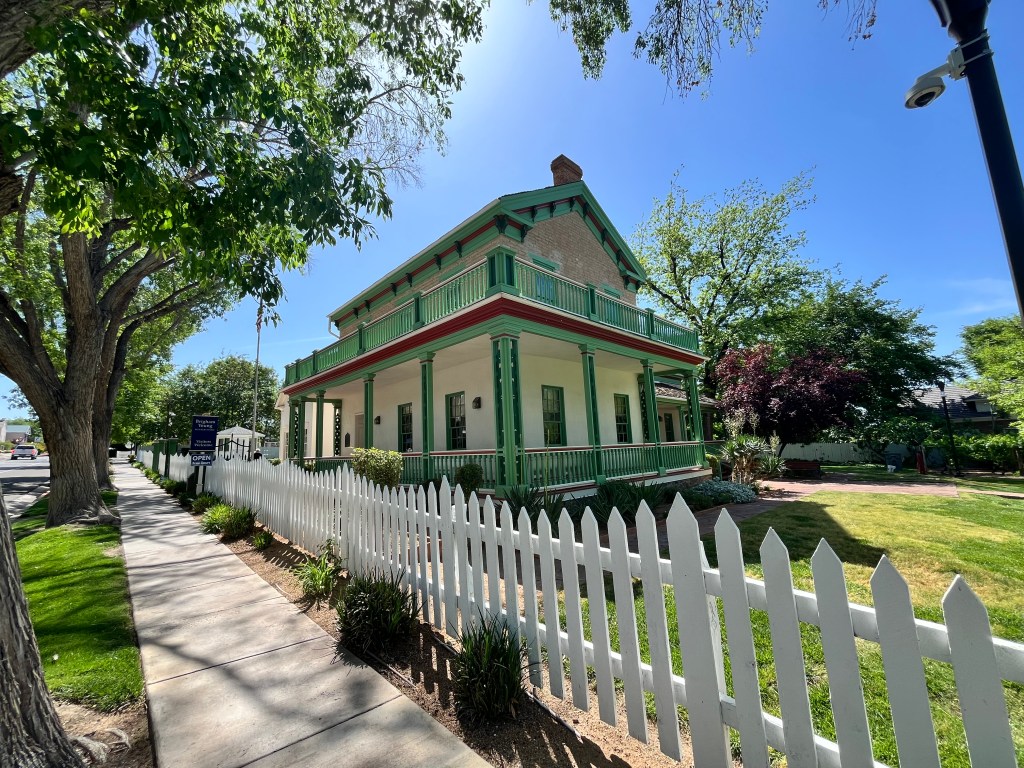
The halfway point on our trip to Wyoming is near St. George, Utah, where we decided to spend a few days. It’s a nice little town, and was the winter home of Brigham Young. Some friends from Yuma recommended visiting his home. Young was the second president of the Church of Jesus Christ of Latter-day Saints (LDS) from 1847 until his death in 1877. He was also the first Governor of the Utah Territory (1851 -1858). The LDS offers free tours of the home and office. I was expecting a large house, but his winter home is a modest three bedroom home.

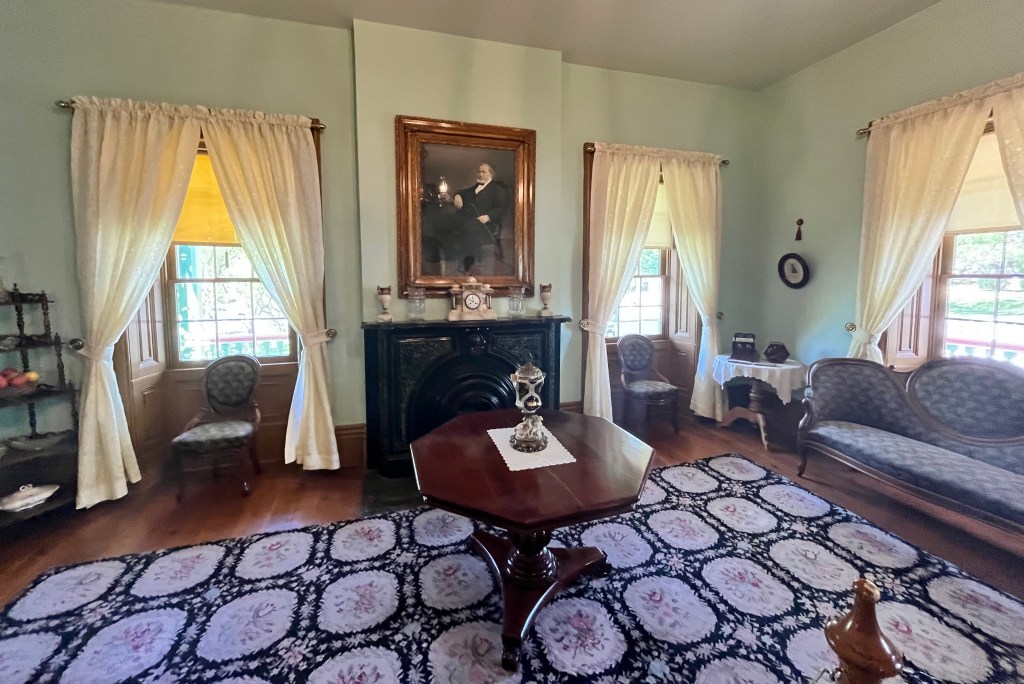
The main room of the house, where they received guests, has a box piano. The legs come off, and the piano can easily be transported between homes on a wagon.

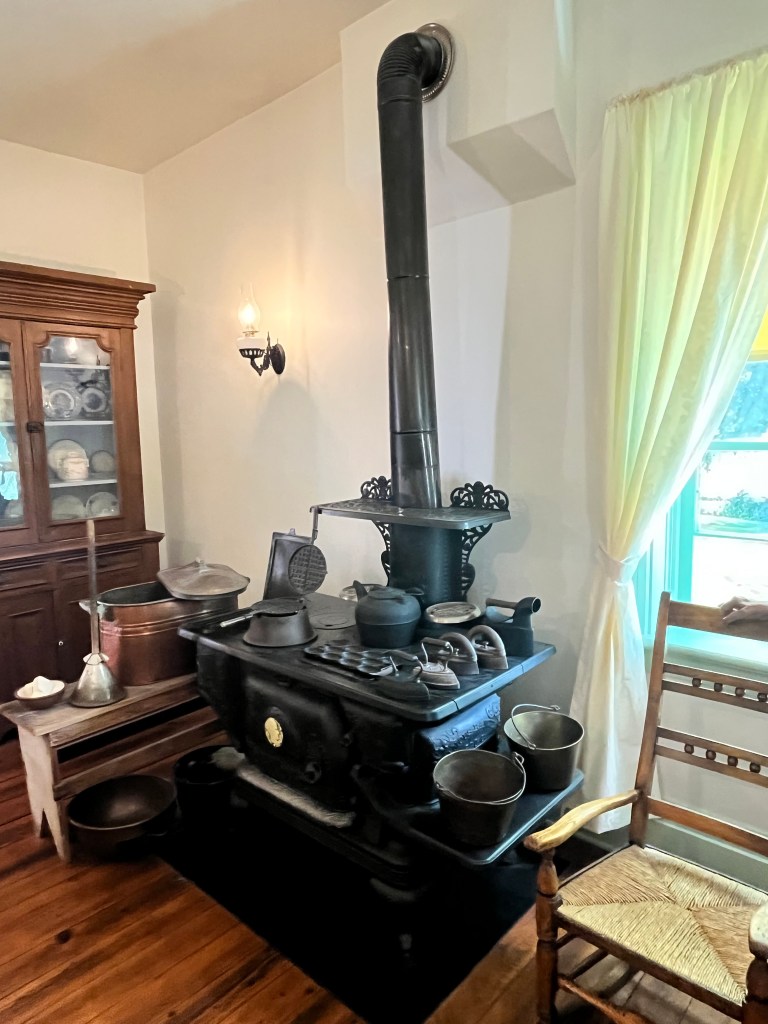
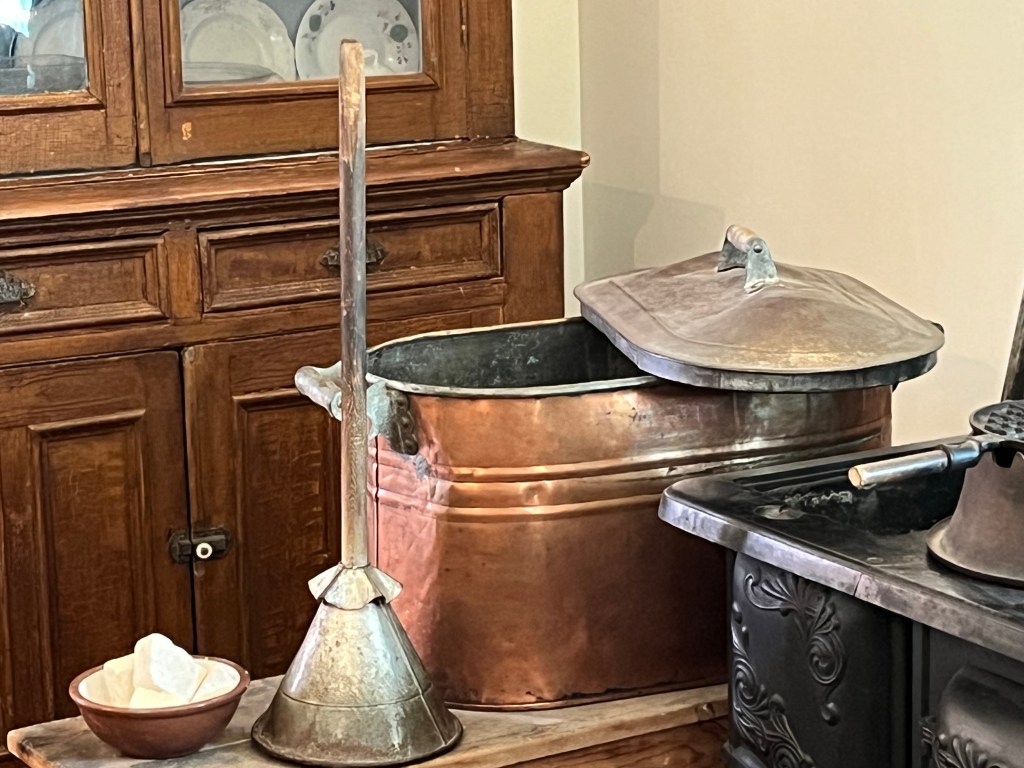
The dining room and kitchen of the house.

To the left of the stove, what looks like a plunger, is actually the “clothes washing machine.” The clothes go into the pail, along with the soap on the left, and the plunger agitates and cleans the clothes. Pretty high tech for the late 1800’s.
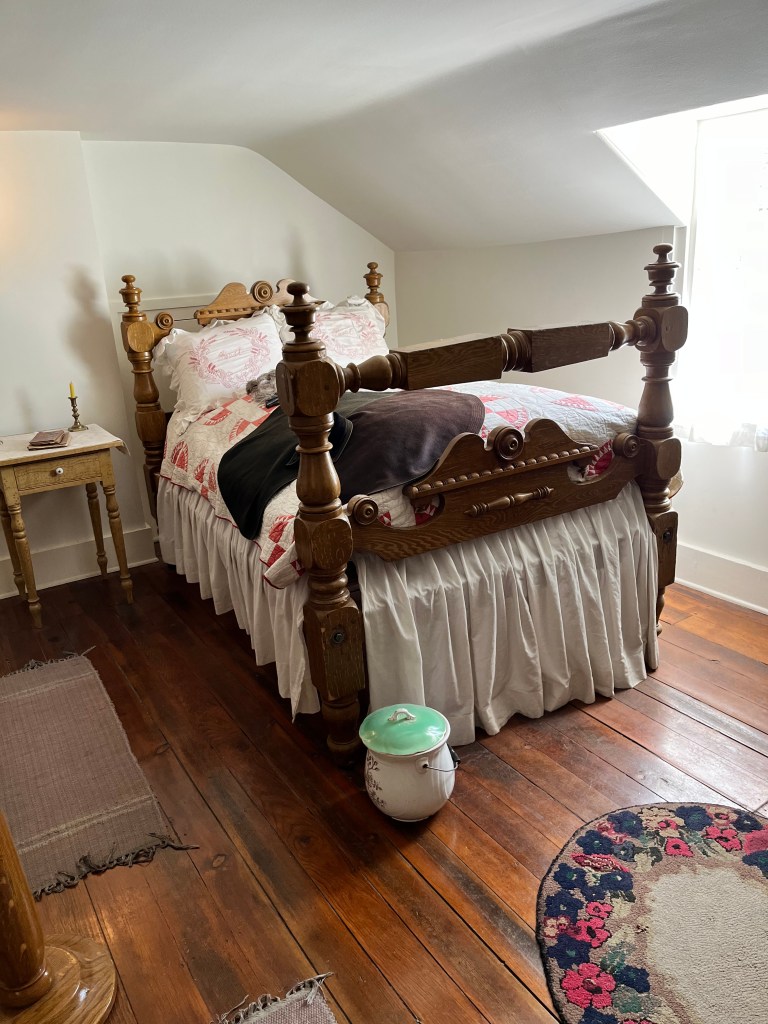
There are three bedrooms upstairs. One for the housekeeper, one for his wife Amelia (it is believed he had 57 wives, but only stayed here with her. She did not have any children), and Brigham’s own bedroom.

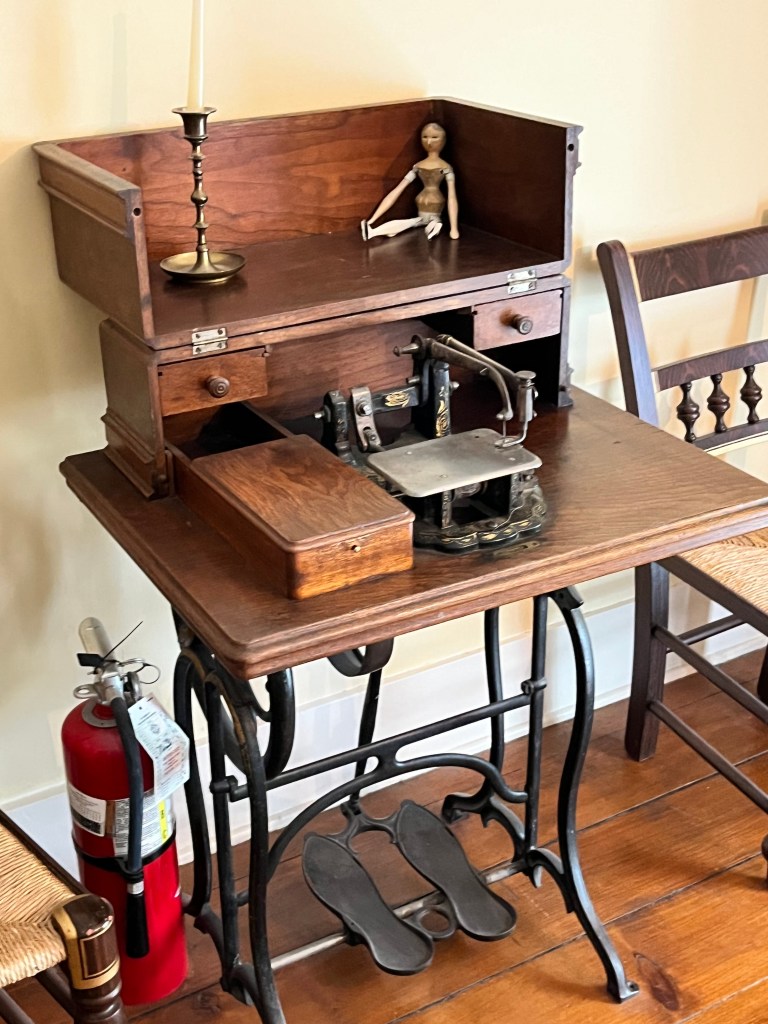
Housekeeper’s room with spinning wheel and sewing machine.

Amelia’s bedroom and travel chest. She wanted a round top on her chest, so no one else could put anything on top of her luggage when traveling. Notice the chamber pot at the end of her bed.
Brigham had a very large bedroom. The drawers on his travel chest are numbered 1 – 4, but they are not sure why he did that. The ceiling in the house has been retrofitted with air conditioning, which is what the holes are.

After touring the home, we went to downtown St. George to see the Tabernacle. Unfortunately, it was closed as they were re-doing the steps. Someone recently fell down the steps, and they decided to make the stairs safer. The Tabernacle is normally open to the public, and is considered a gathering place. They hold concerts and other special events here.

St George Tabernacle

If you are driving on I-15 through southern Utah, you will see a very large white building on the western side of the interstate for miles. This is the St George Utah Temple of the LDS. The Temple is only open to members of the LDS church. All members entering must be dressed (or change into) white clothing inside the temple. White is a symbol of purity, and having everyone dressed the same provides unity.

They do have a visitor’s center on the grounds, which is open to the public. We had a wonderful talk with a church elder at the visitor center that explained the temples are for sacred services and ordinances. There are approximately 300 temples throughout the world, four of them are in Utah. The temple and grounds are spectacular.

distant shot of temple
view from the visitor center
side view and grounds

I always thought the temple was one large building inside, like a cathedral. The temple is a series of rooms where specific ceremonies, or ordinances, take place. The temple is the most sacred place for LDS members. The visitor’s center has photos of the various rooms inside the St George Temple. The church elder said I was welcome to take photos of their pictures. So the following photos are courtesy of the LDS visitor center.

Baptism in the temple is done by the living for those who have died without receiving the baptism ordinance. Living baptisms are not performed in the Temple. Although it’s hard to see from the photo, there are 12 oxen underneath the baptismal font following Solomon’s Temple in the Old Testament.

Baptismal Room

The Instruction Room is where the members learn their purpose in life, through the Endowment Ordinance. The LDS members make covenants with God on how they will live their life on Earth.
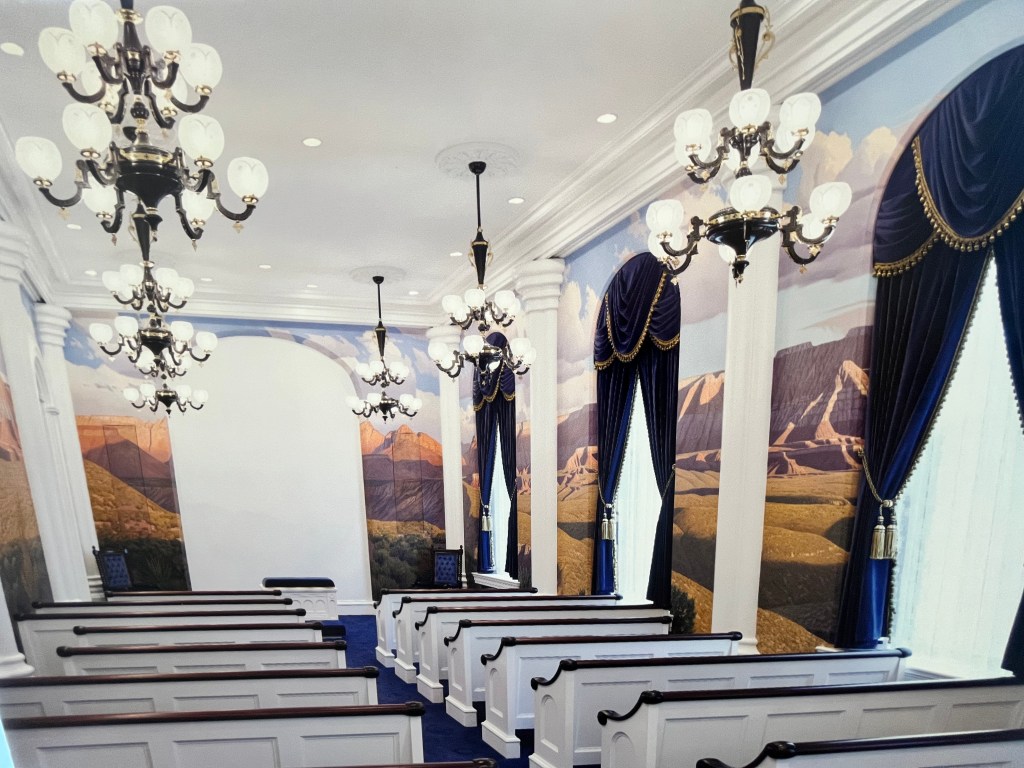
Instruction Room view from back
Instruction Room view from front

The Celestial Room is a place for quiet prayer and reflection. No ordinances take place in this room.
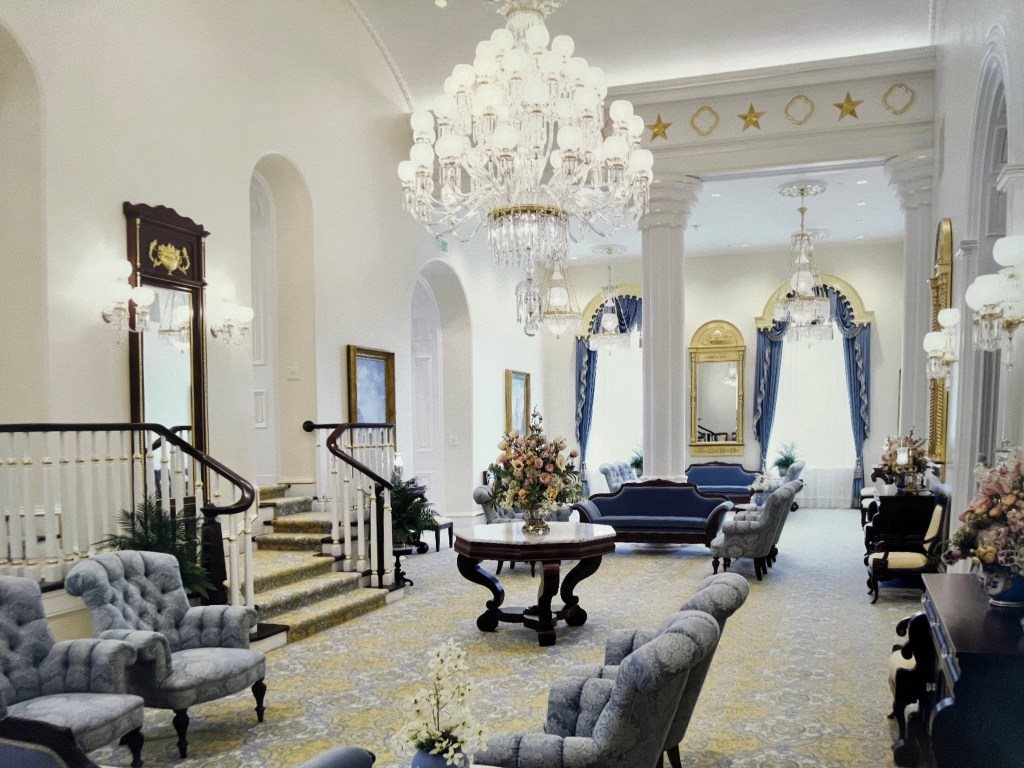
Celestial Room

The Sealing Room is where a bride and groom can be married for eternity. Children born or adopted into an eternal marriage can be sealed with their family for eternity. Only both members of the LDS church can be sealed. If a bride or groom is not a member of the church, they can only have their marriage performed in the church.
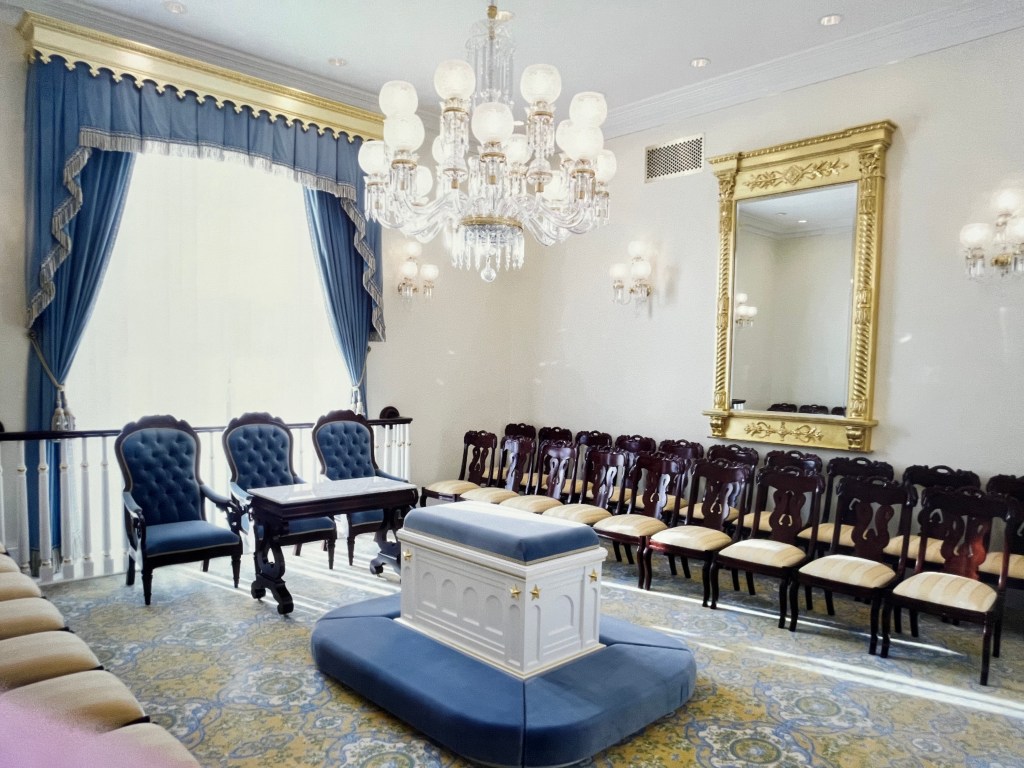
Sealing Room

There is also a large room that will hold special meetings regarding Temple business. I don’t recall if this room had a special name.

We had a “crash course” on the LDS church and their beliefs from the Church Elder at the visitor center, and I believe I have the correct information on the rooms and special ordinances that take place. I would highly recommend stopping in for a visit if you are ever in the St George Utah area. One additional “fun fact” about the temple. When it was completed in 1877, and dedicated by Brigham Young before he passed away, he commented that he did not like the steeple on the temple, and wanted it changed. Since it was already completed, they told him there was nothing they could do, and he went ahead with the dedication.

About 6 months after he died, the temple was struck by lightning, and the steeple, and only the steeple, burned down. The church members believed it was a sign from Young, and they rebuilt the steeple the way he had wanted it done. Below are photos of the original (left) and rebuilt steeple (on the right – that remains today).

Across the street from the temple is the St George Church of Jesus Christ of Latter-day Saints. We did not go into that church.

After a few days of visiting, we continued on our journey to Riverton, Wyoming. We knew we were getting close when we started seeing snow! And the temperature dropped by 65 degrees!

Wyoming

Stay tuned and stay safe! As always, thanks for following along. I believe Makena is getting antsy….!

Quote of the Day: “If you have a bad thought about yourself, tell it to go to hell because that is exactly where it came from.” – Brigham Young

Trains, Automobiles and Guns

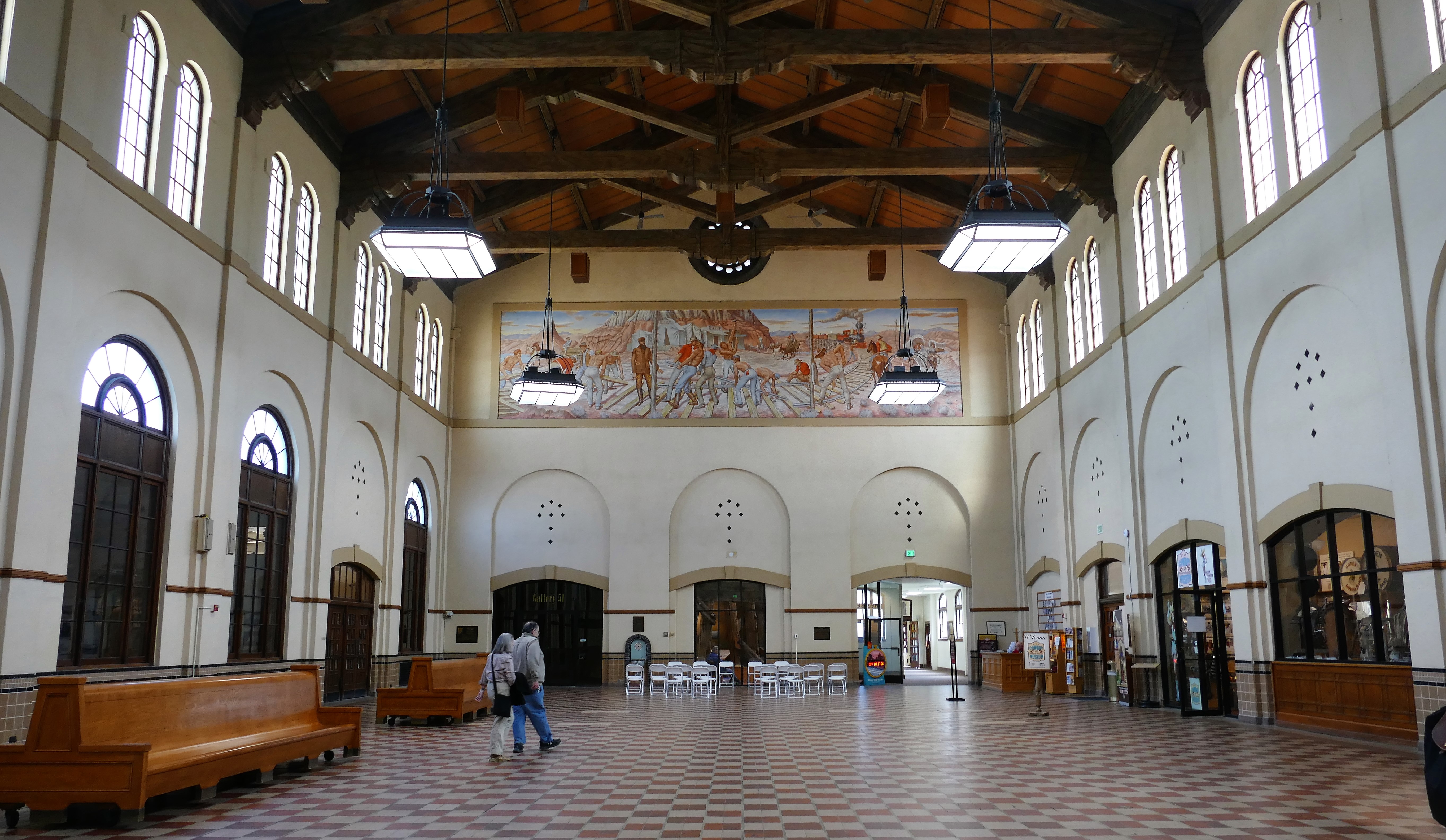
In continuing on with the Planes, Trains, Automobiles and Guns themes (Planes were the last post), we visited Union Station, in downtown Ogden, Utah.  It’s definitely worth a visit if you are in the area.  The station contains four small museums that you can visit, for $7.00 per adult.  The current station was built in 1924, after the previous station burned down.

P1060038 (2)

P1050857 (2)

The Grand Lobby in Union Station

In Wisconsin, we call this a bubbler.  The rest of the country, for whatever reason, seems to think this is a water fountain.

P1050855 (2)

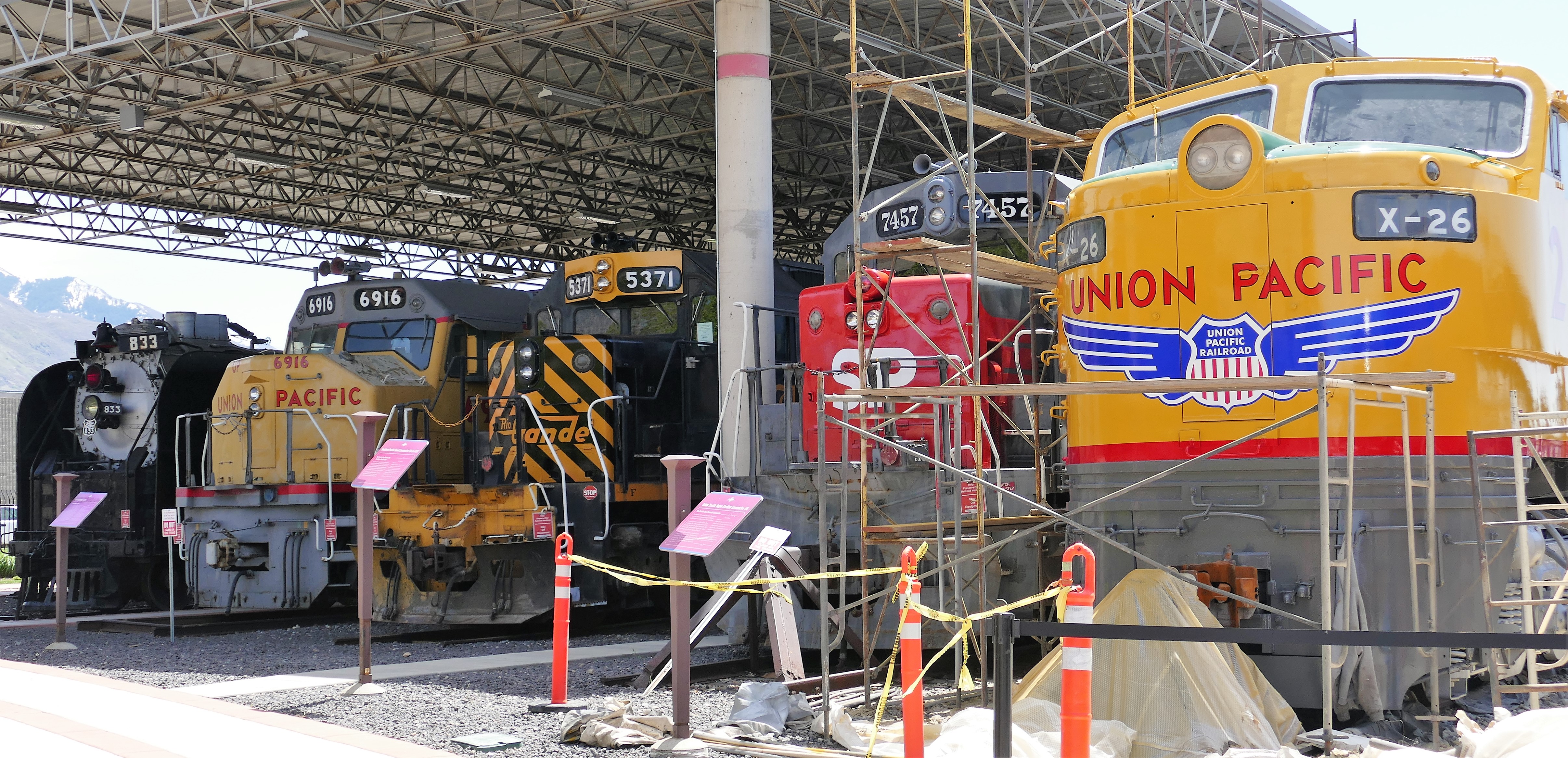
At it’s heyday, 120 trains went through Ogden every day.  Union Station is now used to house several small museums, including an outdoor display of diesel and steam engines.

P1060020 (2)

The Utah Cowboy and Western Heritage Museum has a small space honoring the Utah Cowboy Hall of Fame as well as historic western memorabilia.

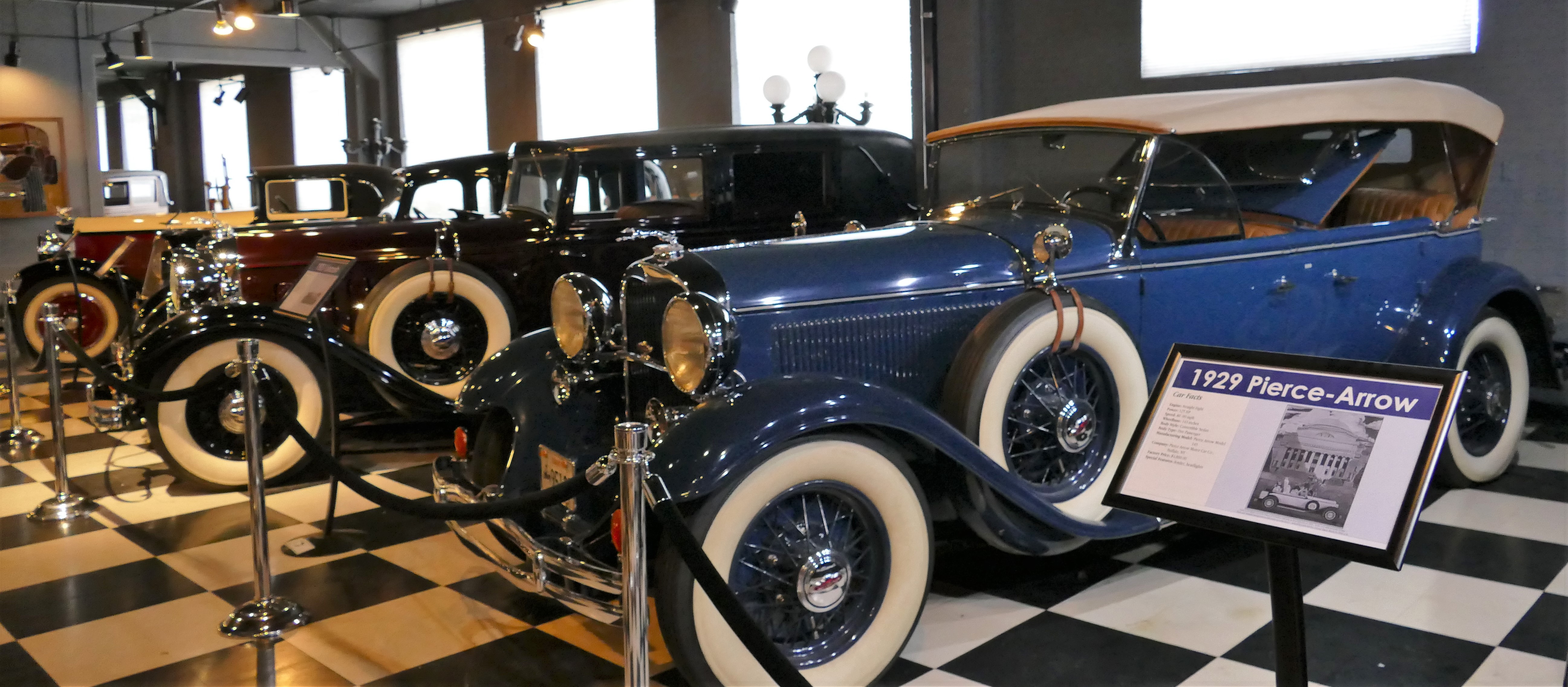
The Browning-Kimball Classic Car Museum has about a dozen old cars on display.  What is unique about the cars is they are all driven out of the museum every year during the annual Heritage Festival in Ogden every May.

The blue car on the right is a 1931 Lincoln Model 202A.

P1050978 (2)Below is the 1929 Pierce-Arrow.
P1050980 (2)

Below, on the far right, a 1929 Durant model 6-60.  The red vehicle is a 1911 Knox Model S Roadster.  The beige vehicle on the far left is a 1930 Cadillac Model 452.

P1050994 (2)

The Utah State Railroad Museum is now the proud owner of the The Golden Spike safe, which was originally held at Stanford University, and contained the original Golden Spike of 1869, a 17.6 karat gold spike used to connect the final rail of the Transcontinental Railroad, connecting the Union Pacific with the Central Pacific in Promontory Summit, Utah Territory, May 10, 1869.

After the 1989 earthquake in California, the museum displaying the safe and spike was damaged, and a new museum was built, with a new display case for the spike.  The safe was then donated to this museum in 2010.  The “golden spike” on display in the safe is the Utah Centennial Golden Spike.

Before trains, people were not really aware of “time.”  There was morning, afternoon, evening and night.  People used sundials to keep track of time.  After trains, “time” became important, and people soon realized that the time in Chicago was not the same as the time in Ogden.  In 1884, the National Railway Time Convention proposed standard time zones, and in 1918 Congress finally passed the Standard Time Act, making the time zones official.

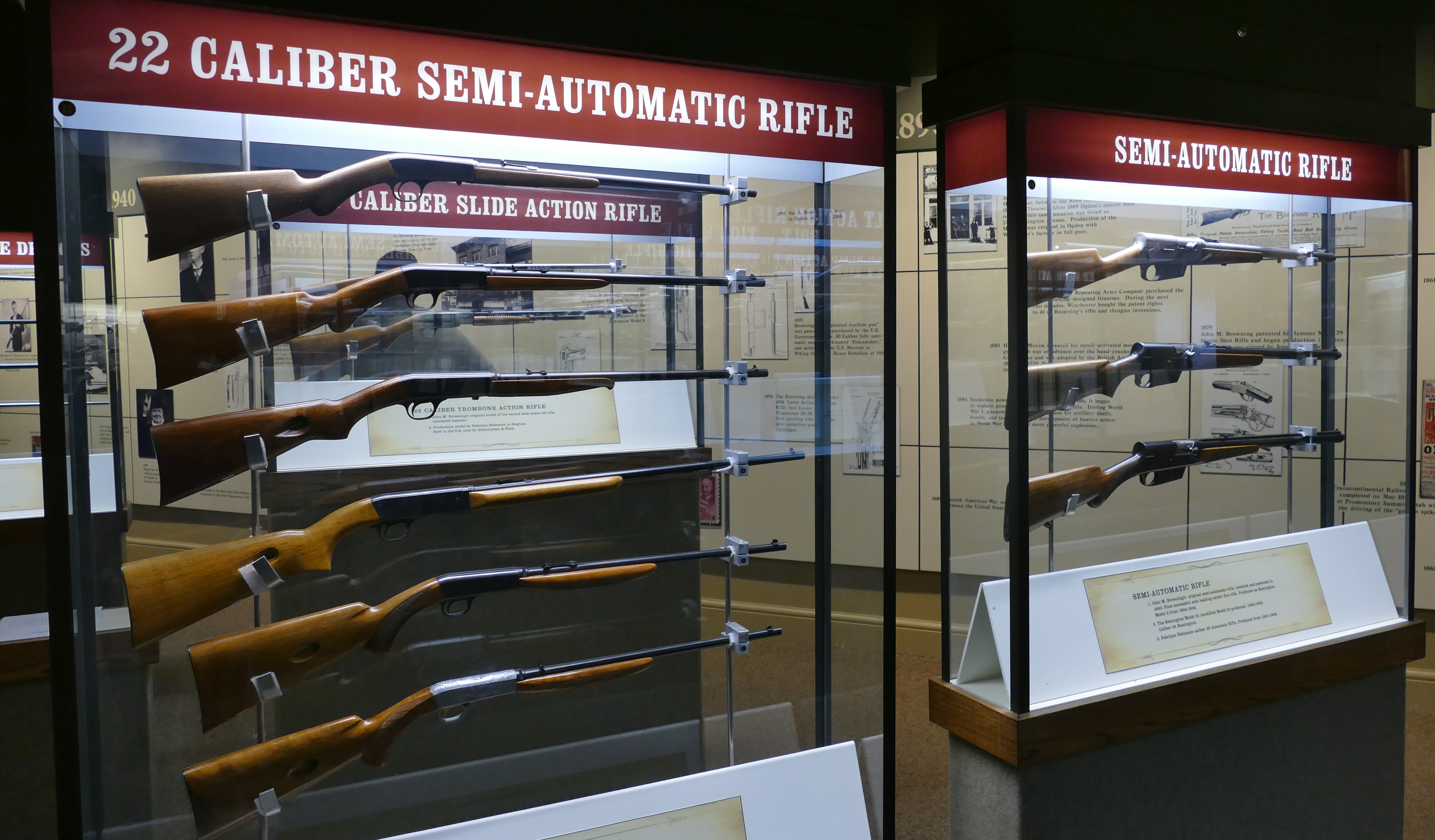
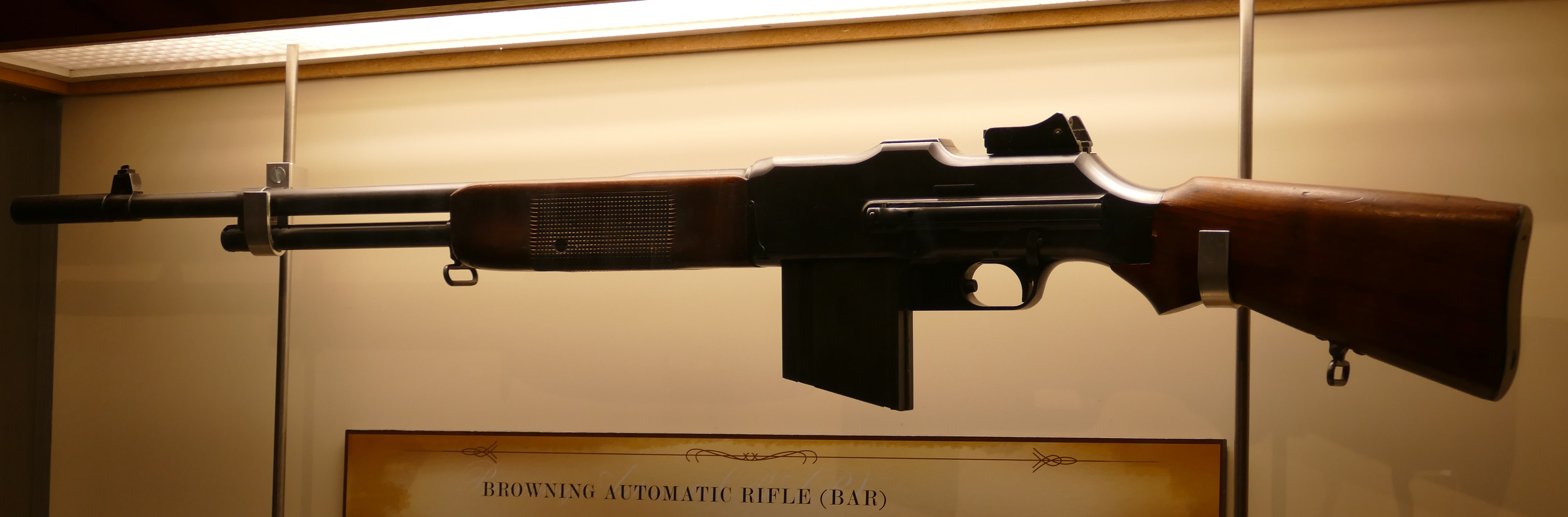
The John M. Browning Firearms Museum  has a large display of firearms.  The museum started with the history of the Browning family, talking about John M Browning’s father, Jonathan.  The family history was a bit confusing, because Jonathan was a polygamist with several wives and lots of children.  (too many branches in the family tree!).  Jonathan was a gunsmith in Ogden, and John followed in his footsteps, working in his shop at young age.  He is considered to be one of the most successful gun designers in history, with many of his 128 patented designs still in use today.   He sold many of his designs to Winchester, Colt, Remington and Fabrique National de Herstel (FN) of Belgium.  Original models of his guns are on display.  They provide an excellent history on the development of rifles, shot guns and automatic weapons.

P1050922 (2)

P1050944 (2)

His very first invention, in 1878, was the single shot rifle (top rifle in the photo below).  In 1883, he sold the patent to Winchester, and in 1885, they started selling Model 1885 in 33 calibers (bottom rifle).

P1050920 (2)

John M Browning also developed a 9mm pistol.  The top pistol was his first prototype, and the other three were patents he sold to Fabrique National (FN).

P1050942 (2)

He developed a number of weapons for the military.

P1050956 (2)

Including this automatic rifle, which was first used near the end of WWI, and continued to be used through the Vietnam War.  It can fire 500 rounds per minute.

P1050967 (2)

In 1911, Browning designed the M1911, semi-automatic weapon used by the military as their standard sidearm.  It was manufactured by Colt, and used until 1986. Below are several variations of the model.

P1050952 (2)

If you are a gun owner, John M Browning probably had something to do with the design and development of the guns that you own.  We enjoyed our visit to Union Station, and highly recommend a visit if you are in Ogden, Utah.

Now it’s back to work…

Quote of the Day:  “Jobs fill your pocket, but adventures fill your soul.” – Jamie Lyn Beatty


Hill Aerospace Museum

After leaving Bryce Canyon National Park, we headed up to Ogden, Utah with our friends Tom and Ellen.  They just stayed one night, and headed up to their summer work camping job in West Yellowstone, MT.  After looking at the weather in Grand Teton National Park, we opted to spend two nights in Ogden.

We enjoy going to museums, and Ogden has several interesting museums available.  It’s a planes, trains, cars, cowboys and guns paradise!  I though about doing one blog to cover all the museums, but I know people like to look at photos, so I will break this up into two posts, and just cover the planes today.  You can always double-click on the photos to enlarge them.

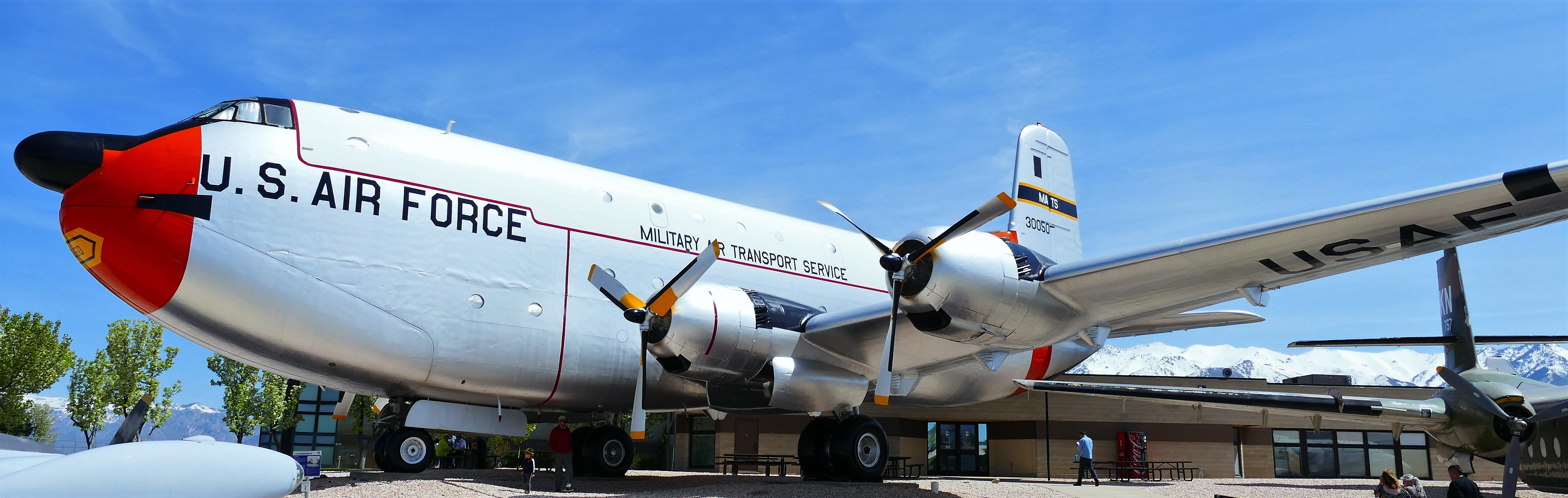
Hill Aerospace Museum, located on Hill Air Force Base (Utah’s largest employer) just south of Ogden, is an excellent place to spend a few hours looking at over 100 planes and exhibits from the Wright Brothers, World War I and II, Korea, Vietnam and current day battles.  They also have a STEM Education program, and the several dozen school children that we saw running around, seemed very excited to learn about aviation history.  The large planes are outdoors.

P1050785 (2)

Hill Aerospace Museum

Hill Air Force Base is tasked with maintenance and repair of planes.  In the exhibit on the Wright Brothers, they focus on the man tasked with helping the brothers maintain the plane.  Charles Edward Taylor is considered to be the world’s first aviation mechanic.  He built the first successful engine for the Wright Brothers, and taught them how to build engines.  He was the lead mechanic on the first transcontinental flight in 1911.  Below is a replica of the 1911 Burgess-Wright Model F Flyer.

In World War I, this Curtis JN-4D “Jenny” was used by the Signal Corp for training.

P1050555 (2)

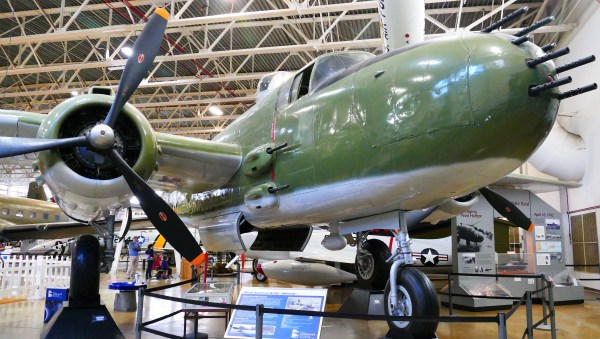
The plane below, a North American B-25J “Mitchell” was used to attack Japan after the Pearl Harbor attack.  Although the planes inflicted minimal damage, troop moral increased, and Japan had to bring their fleet back home to protect their country from direct attack.

P1050507 (2)

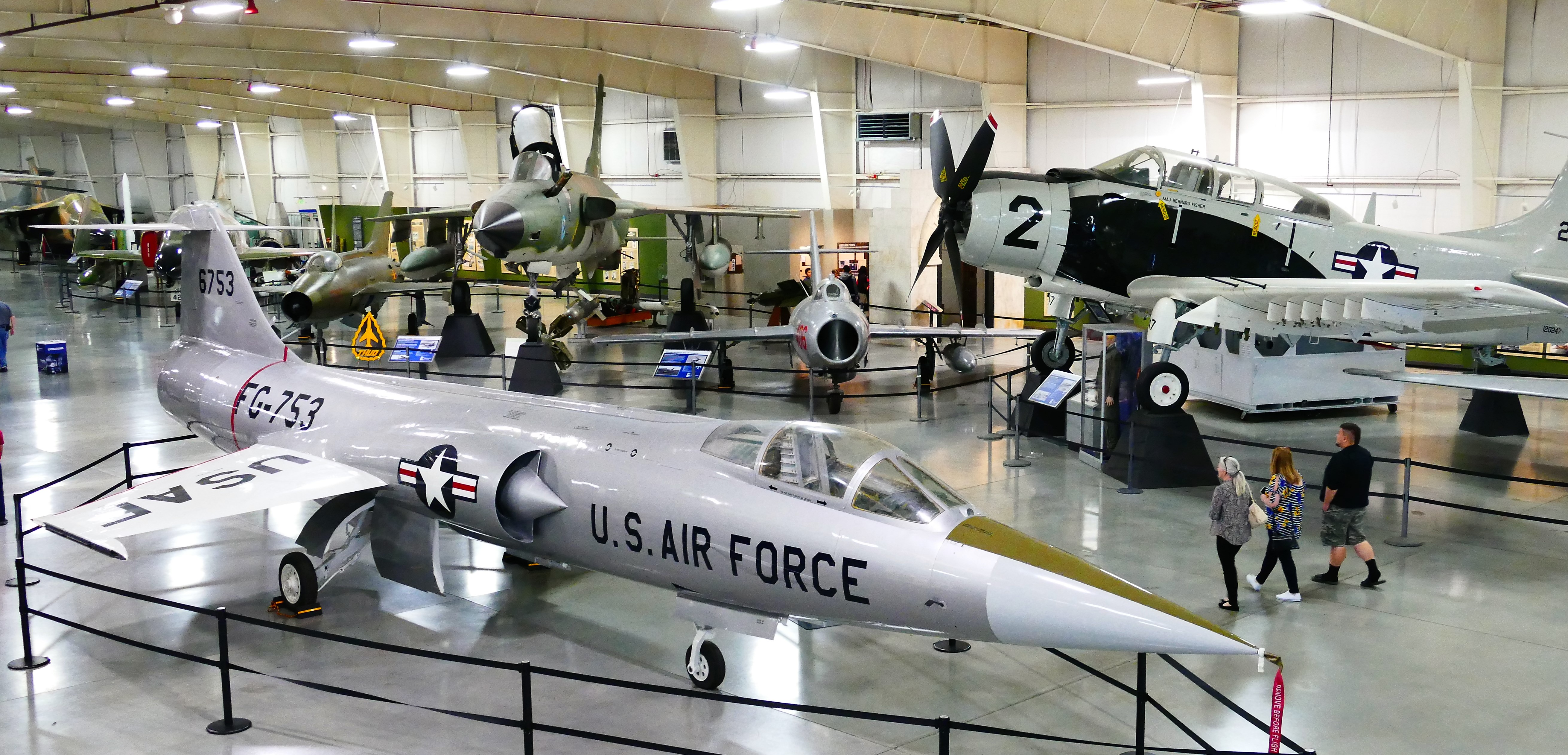
The museum is packed full of planes.  In the first main building, they do not have an area where you can look down on the planes.

P1050542 (2)

P1050567 (2)

The Boeing B-17G “Flying Fortress” were used in WWII for their strategic bombing of targets in Germany.  This plane is painted in the colors of the 493rd bomb group.

P1050580 (2)

The museum has a display on the role women played during WWII.  The number of women employed during WWII increased by 57%, and many women were employed in areas traditionally employed by men.

P1050591 (2)

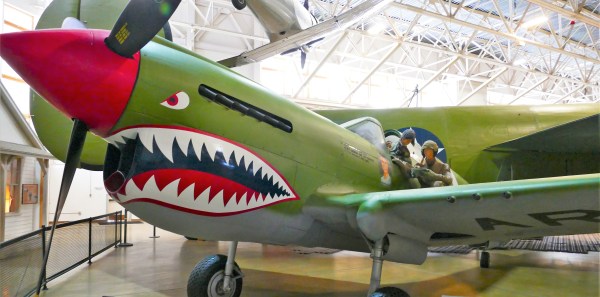
With their red and white shark paint scheme, these Curtis P-40N planes went into combat against Japan.

P1050600 (2)

Curtis P-40N “Warhawk”

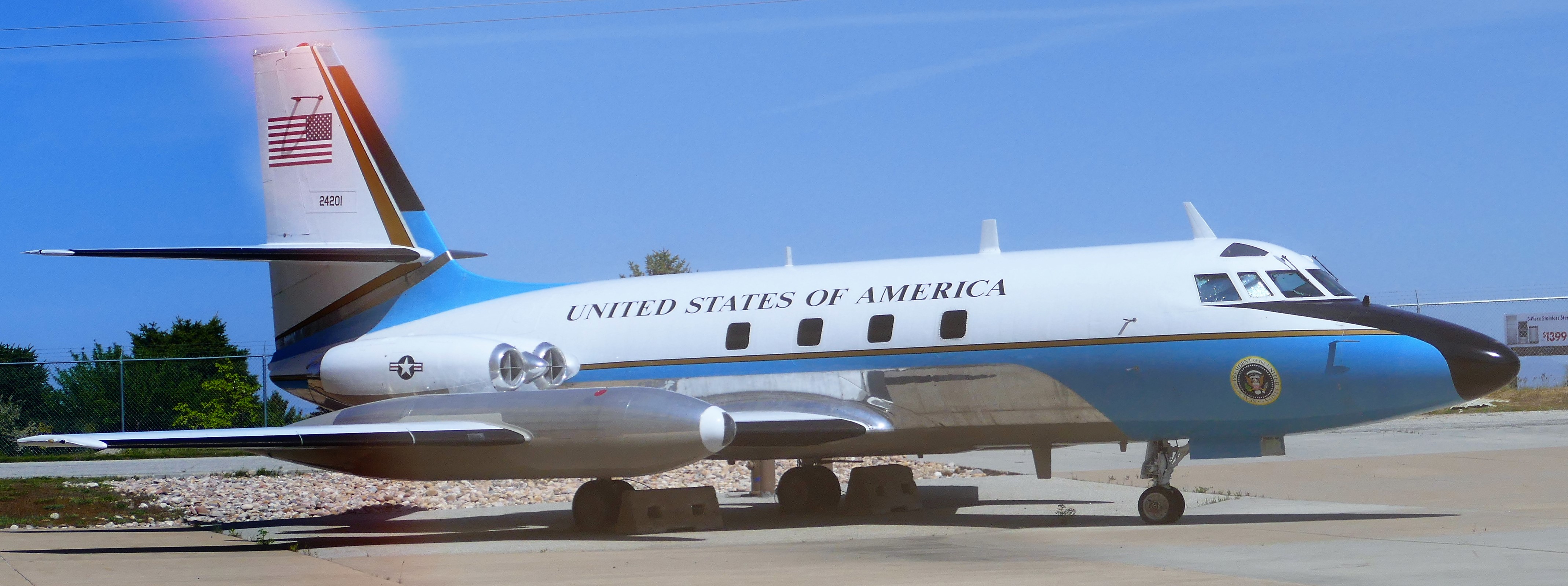
On the way to the second indoor building, we noticed this plane outside in the courtyard, the Lockheed (V) C-140B “Jetstar.” It was used by President Lyndon Johnson.  We were unaware the Presidents had smaller jets at their disposal.  There was no access to view this plane up close.

P1050742 (2)

The second building had some stairs where you could look over the planes from a higher vantage point.

P1050659 (2)

P1050664 (2)

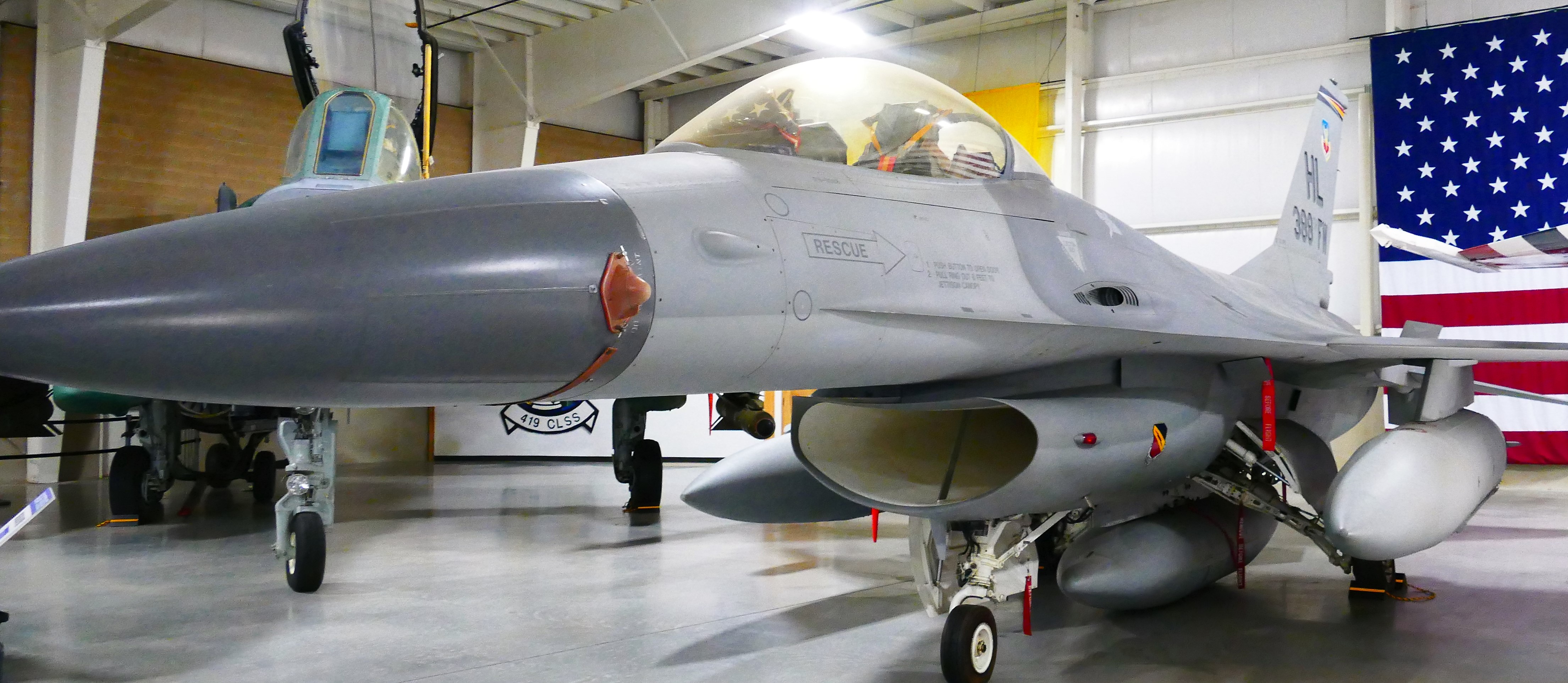
The F-16 “Fighting Falcon” has been the backbone of the Air Force since the mid 1970’s.  At speeds over Mach 2, (about 1400 mph), they are quite impressive! The museum has several on display, and this plane is from the 388th Tactical Fighter Wing assigned to Hill Air Force Base.

P1050720 (2)

The newest addition to the museum, is the F-16A Thunderbird, received in 2017.

P1050739 (2)

The outdoor display is just as impressive as the two indoor buildings.

P1050844 (2)

The B-1B Lancer, put in service in 1986, can carry the largest payload of guided and unguided weapons.

P1050750 (2)

Boeing B-1B Lancer

The C-130 Hercules, not as “svelte” as the B-1B, has been in use since 1956 as a cargo plane for troops and supplies.

P1050770 (2)

They had the back landing door open, to view the interior of the C-130.

P1050765 (2)

P1050780 (2)

B-47 Stratojet

These photos are just a fraction of the planes on display at the museum.  If you are in the Ogden, Utah area, we would highly recommend a visit to this museum (free, donations accepted).   Thank you to all the men and women that have served our country, and keep us safe.


Quote for the Day:  “Hitler built a fortress around Europe, but he forgot to put a roof on it.” – President Franklin Roosevelt