On December 7, 1941, the Japanese bombed Pearl Harbor, setting in motion the creation of the Alaska Highway, formerly known as the Alcan (Alaska-Canada) Highway. On February 11, 1942 President Roosevelt authorized construction of the highway, for the military to get supplies up to Alaska, so North America could defend itself against the Japanese.
Construction officially began on March 8, 1942 near Dawson Creek, British Columbia and was completed just eight months later on October 25, 1942. It was a remarkable feat of design and engineering. This year marks the 80th anniversary of the highway.
QUICK FACTS
*The original highway was 1,523 miles. Over time, road improvements shortened the highway by 35 miles.
*11,000 US troops worked with 16,000 American and Canadian civilians to build the road with 7,000 pieces of equipment.
*Over 133 bridges were constructed along with 8,000 culverts.
*The total cost to complete the highway was $140 million dollars.
*The road opened to public use in 1948.
Here’s a help wanted ad regarding the highway (sounds enticing!)
MILE 0 DAWSON CREEK
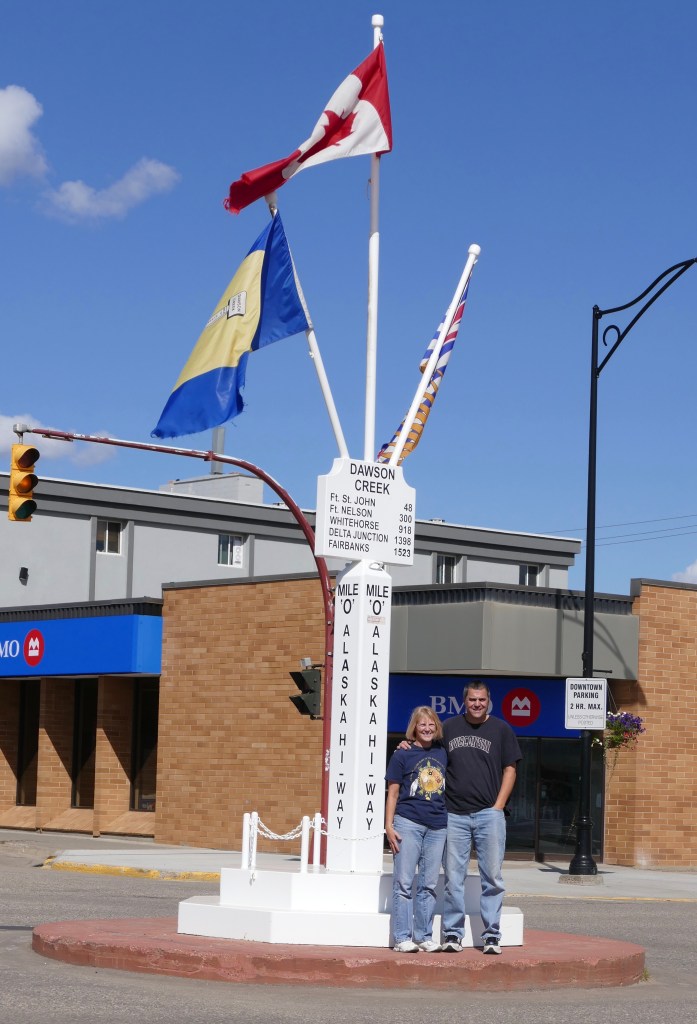
Dawson Creek, British Columbia is the beginning of the Alaska Highway, and is a popular stop for travelers on the way to Alaska. The visitor center has a big sign with the flags of Canada, US and the province of British Columbia. If there’s a sign, we will be stopping!
The “official” mile marker is two blocks away from the visitors center, and most people seemed to miss it. But then again, it’s right smack dab in the middle of an intersection so you have to watch for traffic in all four directions….which we did!
May 30, 2022
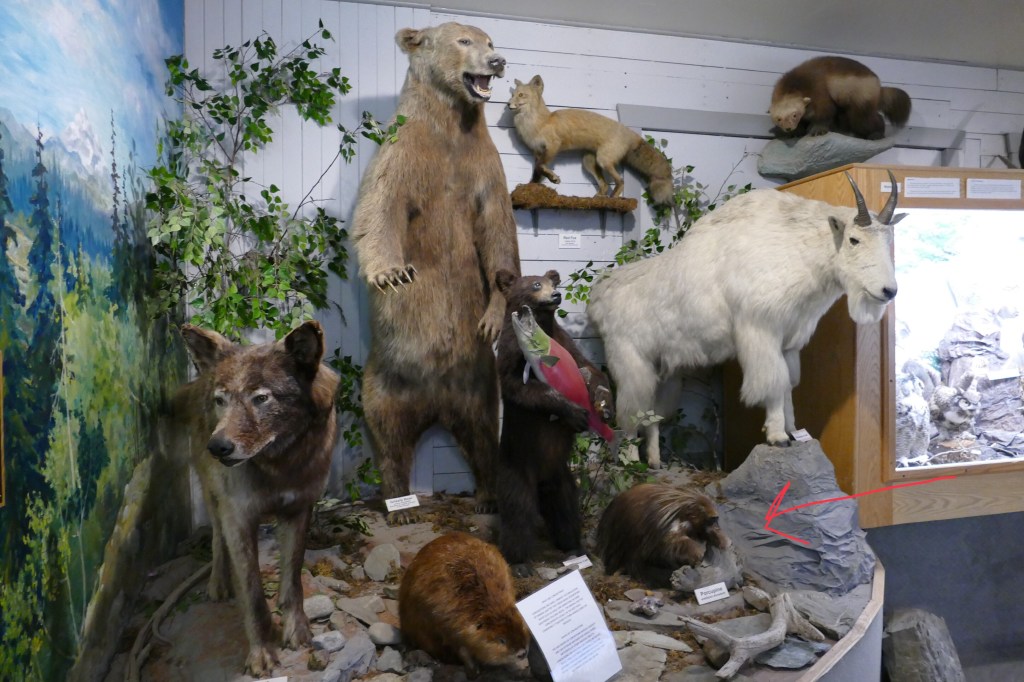
The visitors center has a nice museum, a long movie about the building of the highway, and some displays of wildlife that we hope to see on our journey. The red arrow on the bottom right is pointing to that elusive porcupine. I’ve been looking…still no luck!
The people running the visitors center obviously have a good sense of humor, as some of the mannequins have masks in their hands! All the locals have been patiently waiting for the tourists (and our money) to return!
We went out to breakfast with Karen and Al at Stuie’s Diner in Dawson Creek. The 1950’s themed diner is in an old railroad car, and has a lot of Elvis memorabilia. Definitely worth a stop – the food was good and reasonably priced!
Stuie’s Diner
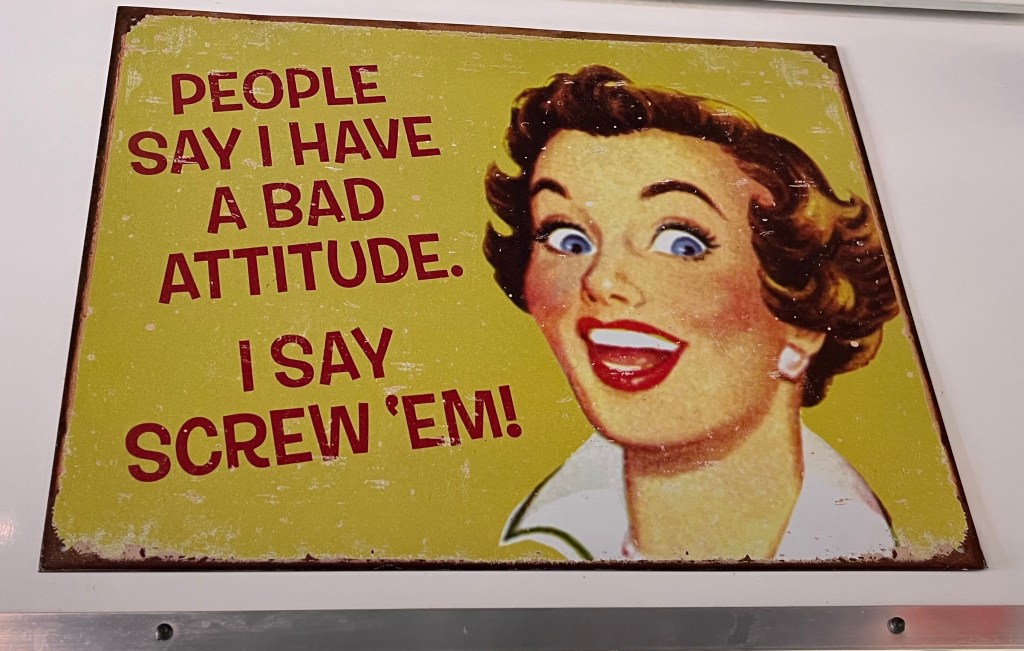
I’m going to use this sign on the wall at the diner for my Quote of the Day:
If interested, here are the Instagram posts from June 1 to June 15, 2022. I will continue to use Instagram for quick status updates, and the blog for more detailed posts. Karen and Al arrived yesterday afternoon, happy to be back on schedule.
We hope everyone is doing well. We have spent the last six summers in the Grand Tetons/Yellowstone National Park area, and the photos that we have seen from the flooding are devastating.
Today is Monday, June 13, 2022, and I’m going to give a current update on our travels. We are driving today from Teslin, Yukon to Whitehorse, Yukon where we will be for 4 nights, before making our final 387 mile stretch into Alaska. If all goes according to plan, we will cross the border for our summer stay in Alaska on Saturday, June 18th.
BUT NOT EVERYTHING GOES ACCORDING TO PLANS…
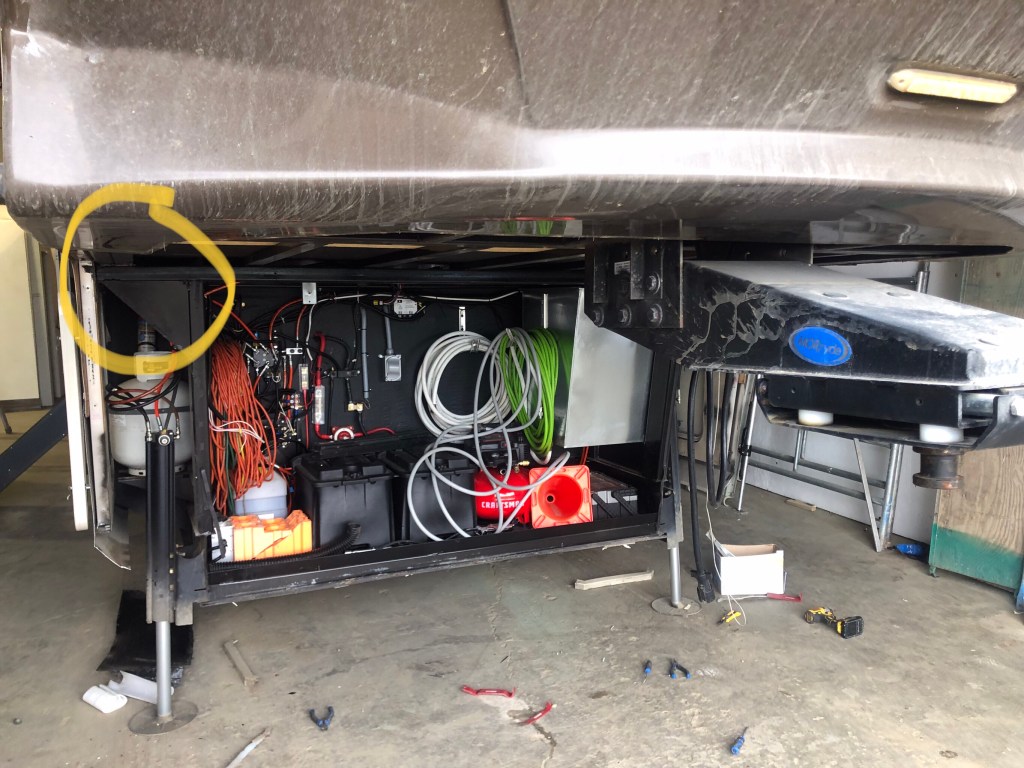
On Wednesday, June 1, Dan and I, along with our friends Karen and Al, arrived at Pink Mountain, British Columbia, for a quick one night stay. Unfortunately, Al and Karen noticed a serious issue with their Grand Design Solitude 5th wheel. There was a crack along the bottom on the front of their 5th wheel. And when they were hitched up, the crack expanded, indicating they may have broken a weld somewhere on the frame. This crack was not there the day before, so it happened while driving between Dawson Creek and Pink Mountain.
To make a long story short, Al made dozens of calls to try and find someone that could look at and repair their RV. He contacted many places in Fort Nelson, which was our next stop, but had no success. He was able to find a place in Fort St John, about 100 miles East of our location that would look at it, but getting it there safely was another issue. They have Good Sam Roadside Assistance (we use Coach-Net) and had a very positive experience with Good Sam in locating a towing company that could safely do the job of moving their RV. This is why having an RV specific roadside assistance program is an absolute must if you own an RV.
This is a sight you don’t want to see when RV’ing. Al had to drive the truck/5th wheel on to the flat bed. It’s the only way to get the 5th wheel on to the flatbed. Their dog Cody was not allowed to ride in the tow truck, and had to stay in their truck for the 100 mile drive.
Karen and Al wanted us to continue on our journey, so we said our goodbyes, and we have been traveling on our own since June 2nd when we departed Pink Mountain. I’m posting this now, because I’m happy to report that Karen and Al found a place that was not only willing to do the repair, but made it a priority and worked all day, every day on it for 5 days straight.
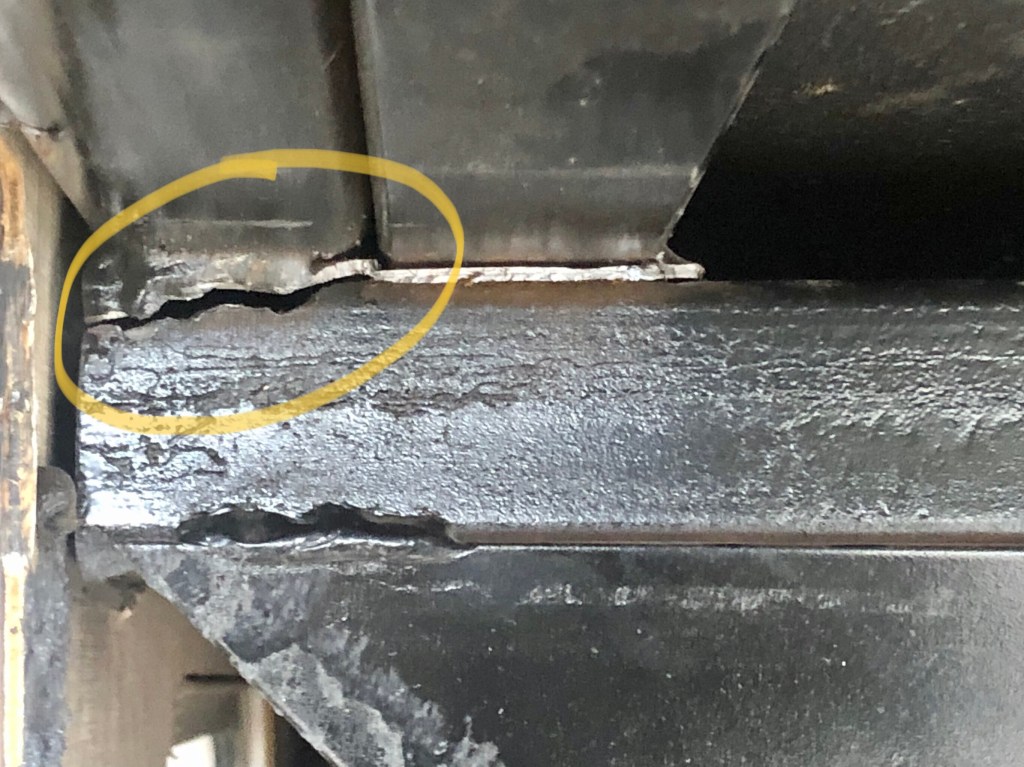
Here are some photos, from Karen and Al, of the damage. The weld broke on both sides, and the repair shop had to remove the damaged beam and replace it with a new one. The repair shop had to remove the skin and doors off the front panel of the RV. The circled area is where one of the two cracks occurred.
Here is a close-up of the damaged beam.
They had to remove the old beam, and put in a new beam.
It was a very extensive repair, but they are back on the road, and putting on a lot of miles to catch back up with us. Hopefully by Tuesday they will arrive in Whitehorse and we will be back traveling together.
Once we knew things would be repaired, we decided to stay in Teslin for a few days, to give them time to catch up. The campground here is nice, right on the water. And it has good wi-fi, so I have been able to get caught up on writing some blog posts. I have several ready to go in the next few days.
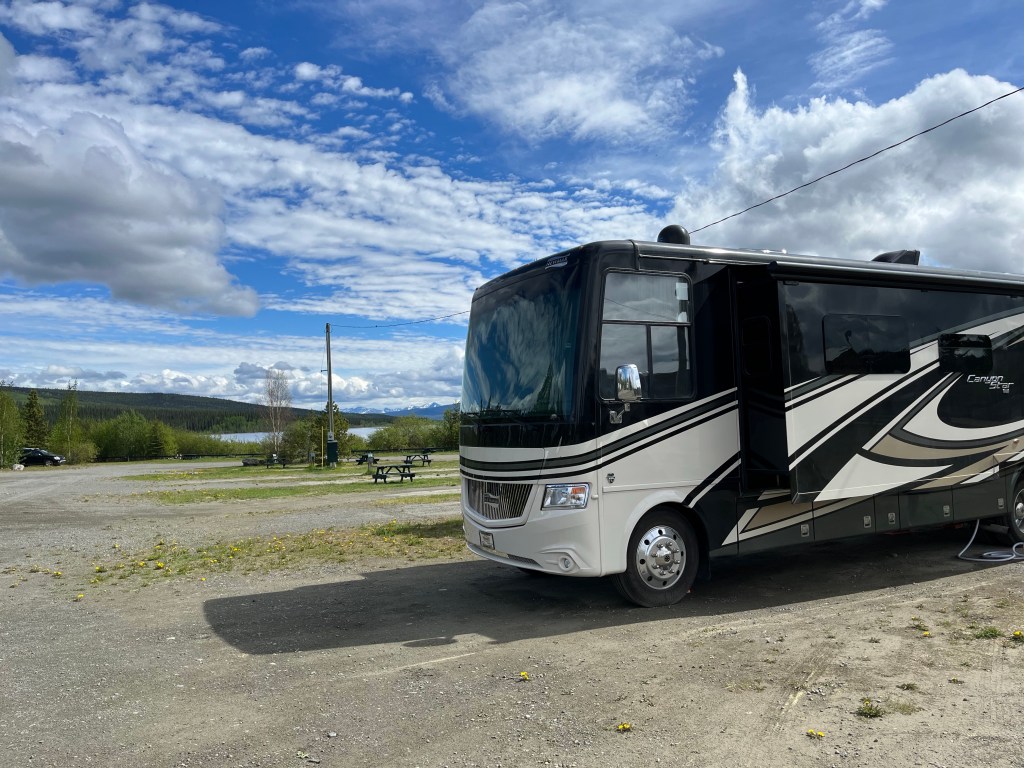
We have a nice view of the water from our spot. This campground fills up every night, and empties every morning. We have enjoyed watching the RV’s arrive and depart. There has been one issue that has come up during our stay.
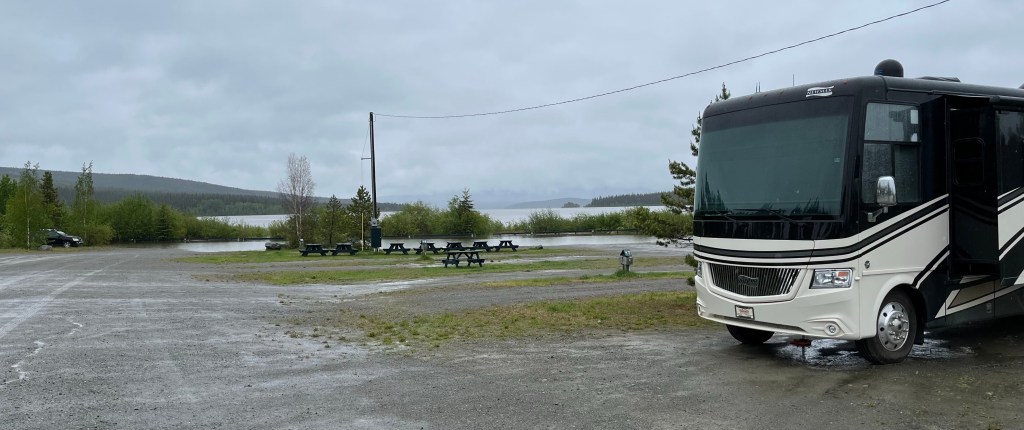
You can see the lake off in the distance. Since we have arrived, it has rained and rained. The lake has risen, and has started to flood this campground. We are fine, but are happy to be leaving. Our lake view site is becoming a lake front site.
All of the white posts along the bushes in the photo below are the electrical posts for the waterfront sites.
They moved the picnic tables from those sites, but if the rain continues, they may need to move them again.
According to the weather forecast, the rain should stop by Wednesday. Hopefully the water will quickly recede and not cause any further issues for this campground.
Quote of the Day: “Every problem is a gift. Without them we wouldn’t grow” – Tony Robbins
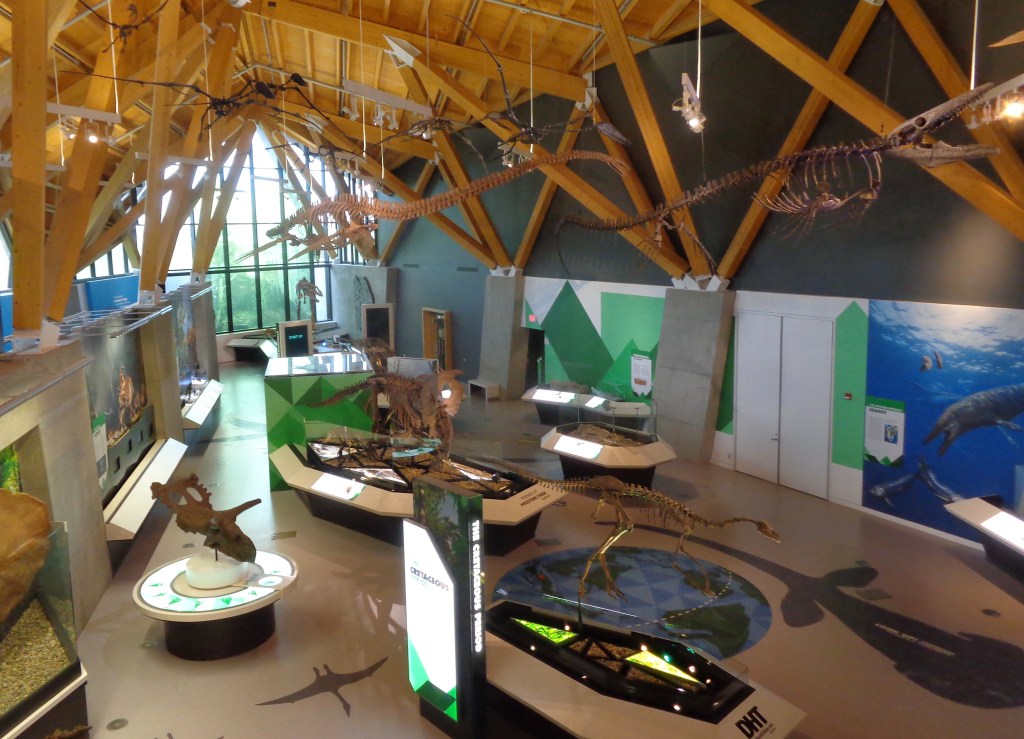
We left St Albert and continued on our journey towards Alaska, stopping in Grand Prairie, Alberta for a few nights. Since the weather had rain, rain and more rain in the forecast, we opted to stay a few days in Grand Prairie. Going to museums are always excellent ideas on rainy days, so the four of us headed out to the Philip J Currie Dinosaur Museum, located about 15 miles from Grand Prairie.
According to a plaque in the museum, Philip Currie found a toy dinosaur in a cereal box when he was six years old, and he decided to be a paleontologist. While he was working on his PhD, he started working for the Provincial Museum of Alberta (now called the Royal Alberta Museum) in Edmonton. Dr. Currie helped to found the Royal Terrell Museum of Paleontology in Drumheller, Alberta.
This museum is located near the Pipestone Creek Bonebed, where the remains of a Pachyrhinosaurus was discovered by a local teacher, Al Lakusta, in 1974.
Philip J Currie Museum
The museum has a platform with displays on the top floor, overlooking the main exhibits. It’s a bit hard to see the dinosaur’s hanging from the ceiling. There was a light of natural light in the museum, which made it hard for photos.
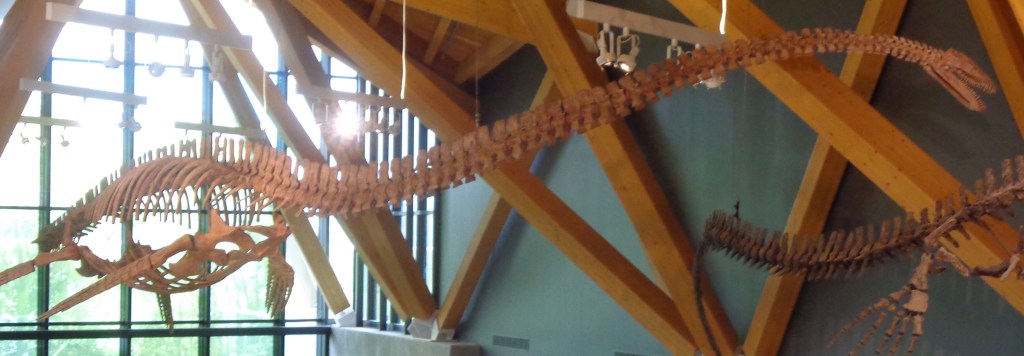
The Thalassomedon was a sea-dwelling reptile belonging to a group of plesiosaurs called elasmosaurs. They are known for their very long necks (62 vertebrae) and small heads. They have large, paddle-like limbs, and were around 40 feet in length.
Thalassomedom
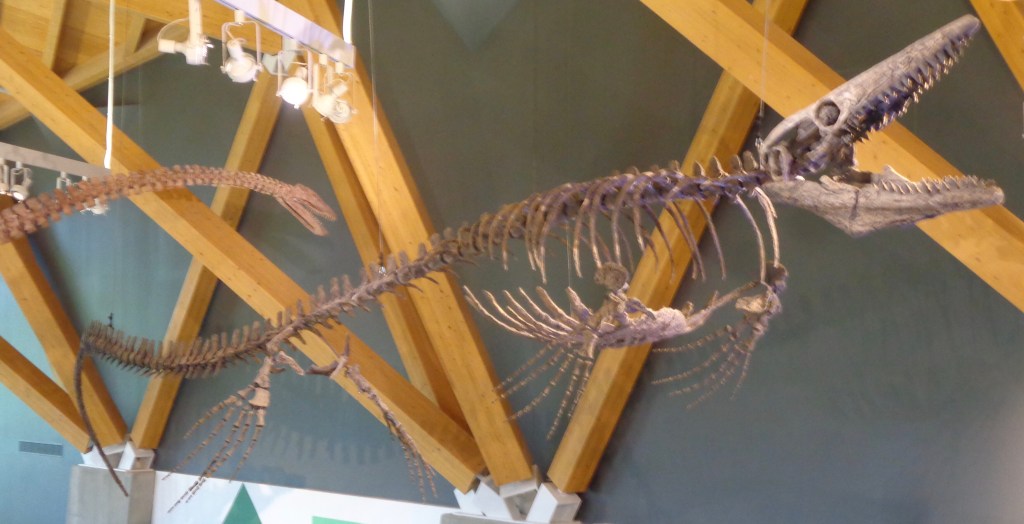
The Tylosaurus is marine reptile, not a dinosaur. It was found in southwestern Manitoba, and was about 33 feet long.
Tylosaurus
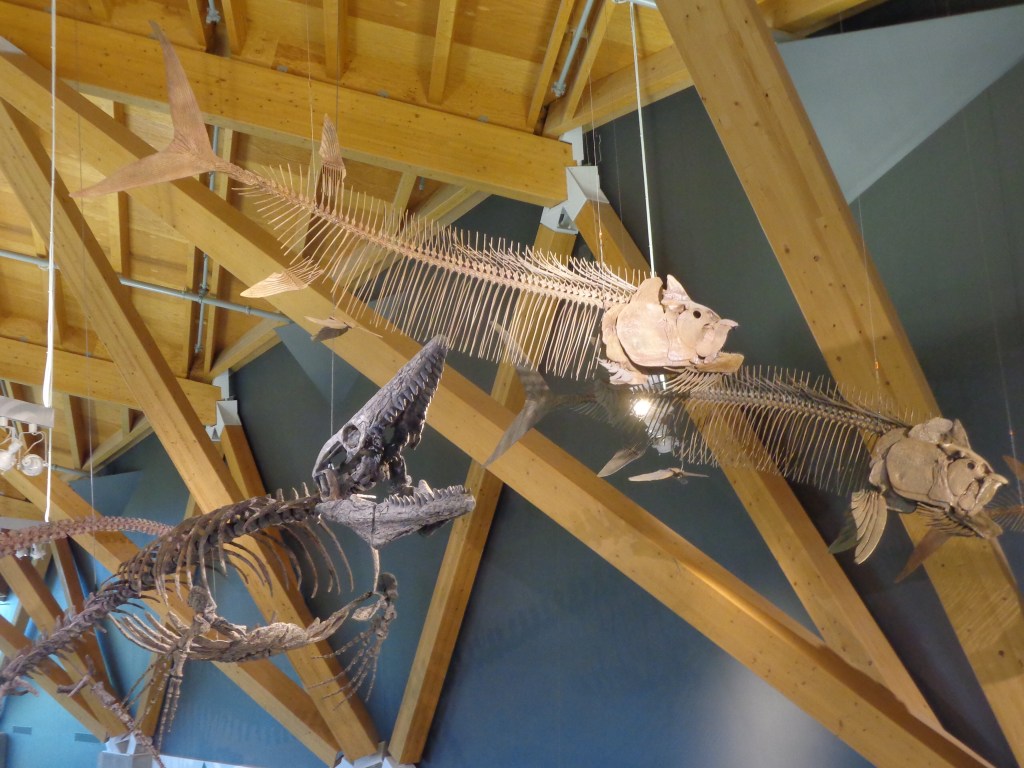
The two big fish (about 12 feet) next to the Tylosaurus are called Ichthyodectes. Fossils of these fish have been found from Canada all the way down to Texas.
Tylosaurus (left) and Ichthyodectes
A Saurornitholestes and some other unknown creature!
Below is a Struthiomimus, a two-legged dinosaur that looked like an ostrich. It has a small head on a long neck, with long legs that allowed it to run quickly.
The Pachyrhinosaurus was a large four-legged dinosaur. This was the species found in the nearby bonebed back in 1974.
Pachyrhinosaurus
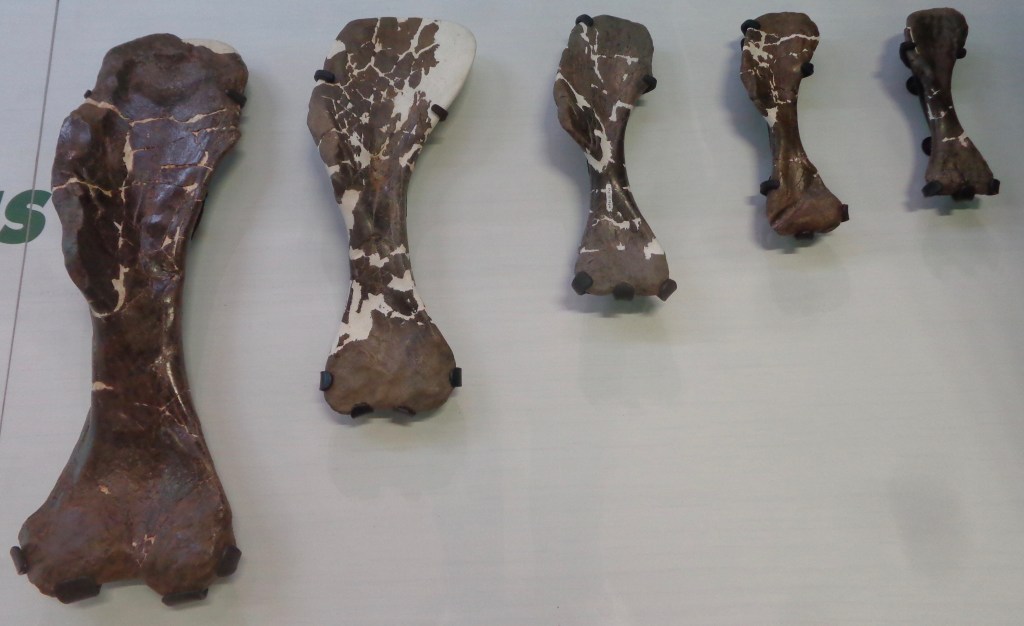
All of the humerus bones (upper arm) below were found at the Pipestone Creek bonebed. They are all from Pachyrhinosaurus’s of various ages.
\
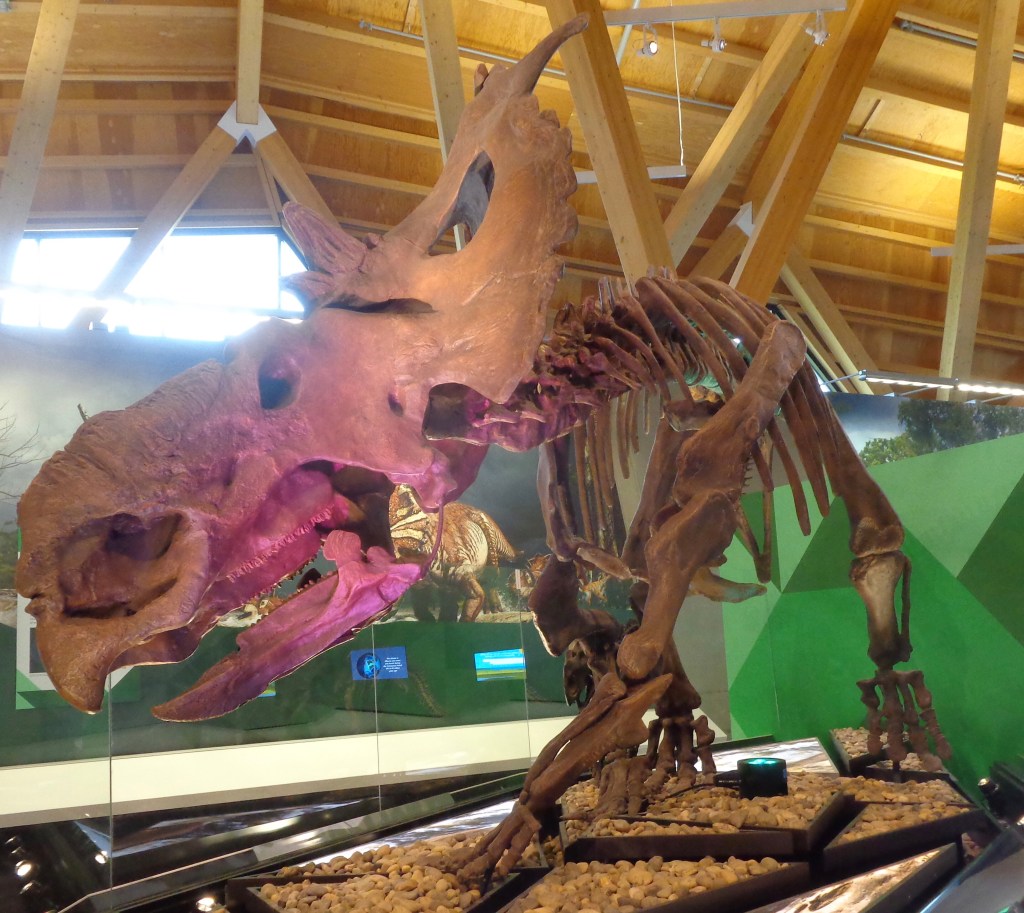
This Styracosaurus skull was found in southern Alberta.
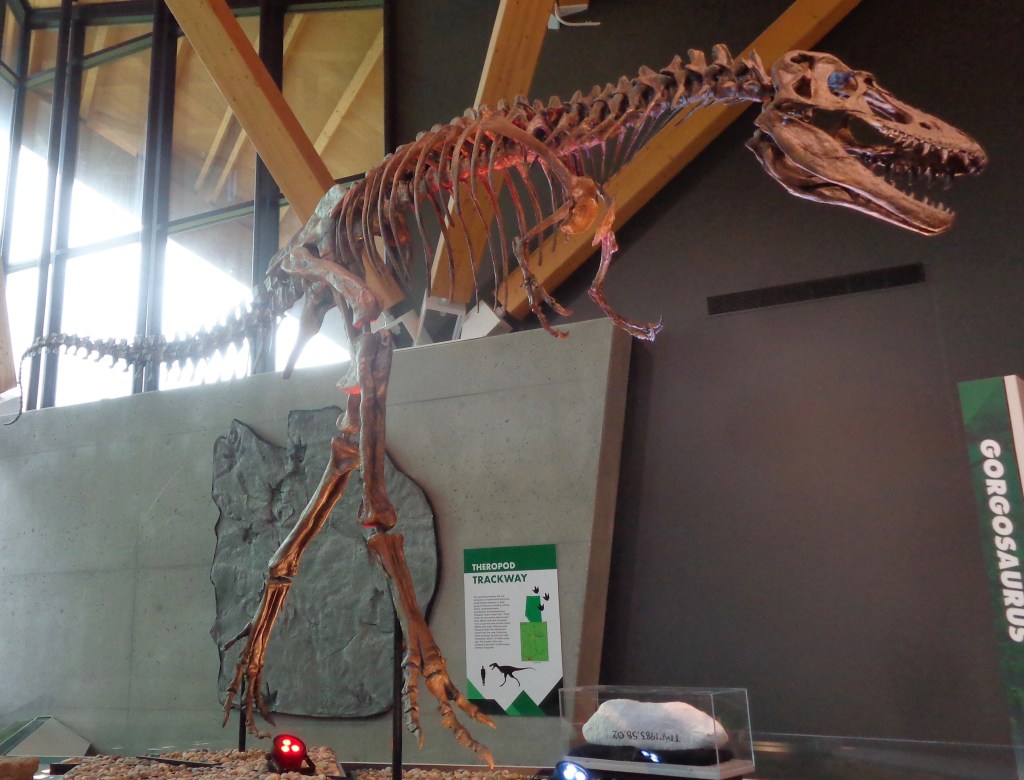
The Gorgosaurus skeleton, found in southern Alberta, is lizard about 26 feet in length, nose to tail.
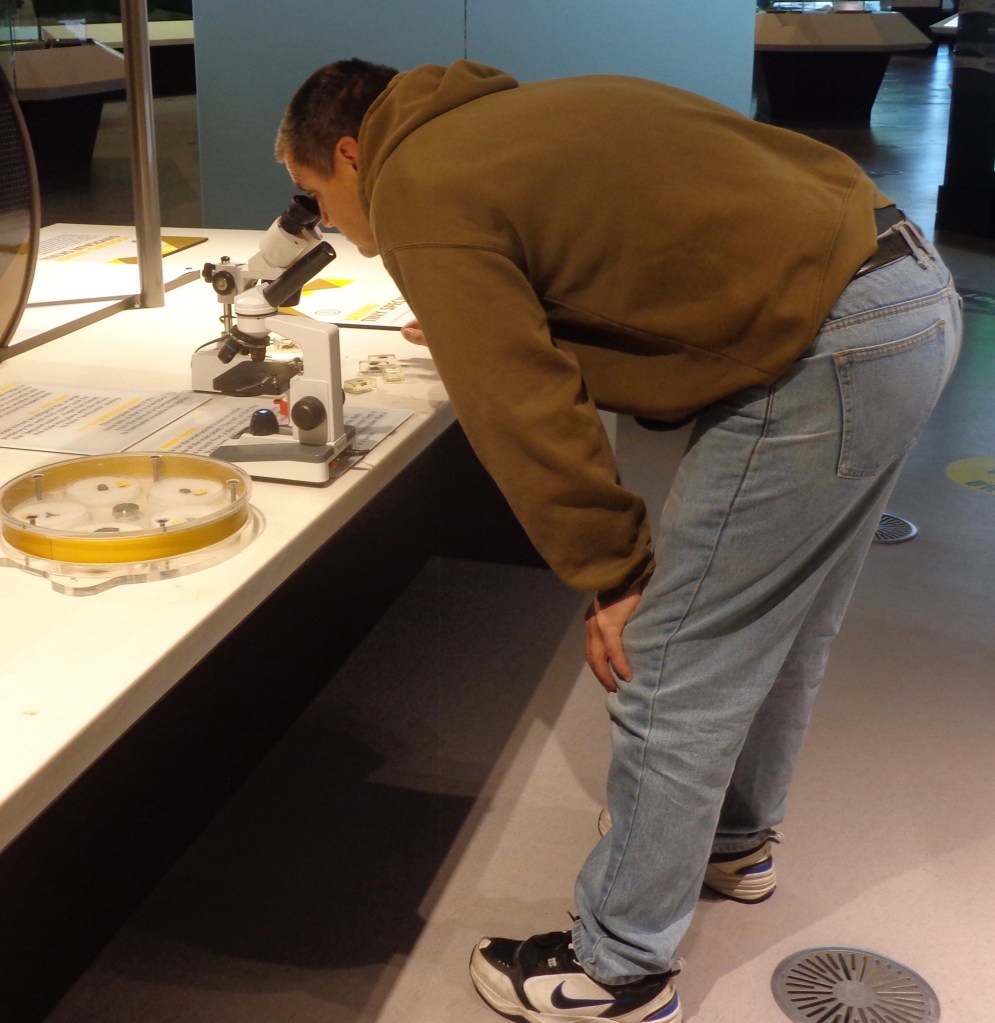
The museum has an educational area, where you can look at slides of insects and other tiny specimens.
Math teachers like science
This is the Fossil Prep Lab where volunteers and staff are currently working on cleaning and stabilizing fossils that are found in the nearby bonebed.
A separate portion of the museum goes into the discovery of oil and gas in the region. It is a wonderful museum, with many more fossils and dinosaur’s on display than I have listed here.
Quote of the Day: “Dinosaurs are the best way to teach kids, and adults, the immensity of geologic time.” – Robert T. Bakker
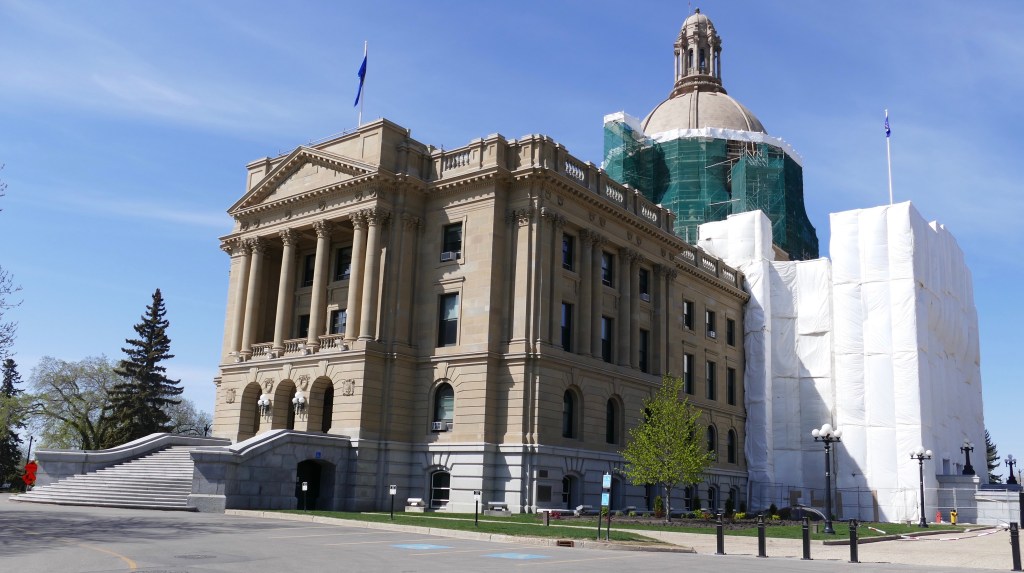
After 5 days in High River, Alberta, we said our good-byes to Don and Kathy and moved on to St. Albert, just west of Edmonton, Alberta for a few days. We were there during the “long weekend,” as Victoria Day is referred to in Canada. Victoria Day was a good day to take a tour of the Alberta Legislative Building. We got a bonus parade/cannon firing that we were not aware was going to happen after our tour was completed.
The exterior of the 106 year old building is in the third and final year of reconstruction of the windows and sandstone exterior.
Below is a photograph of the exterior of the building before the remodeling started.
Inside photos of the rotunda. The fountain was built in 1959 for the visit of Queen Elizabeth II.
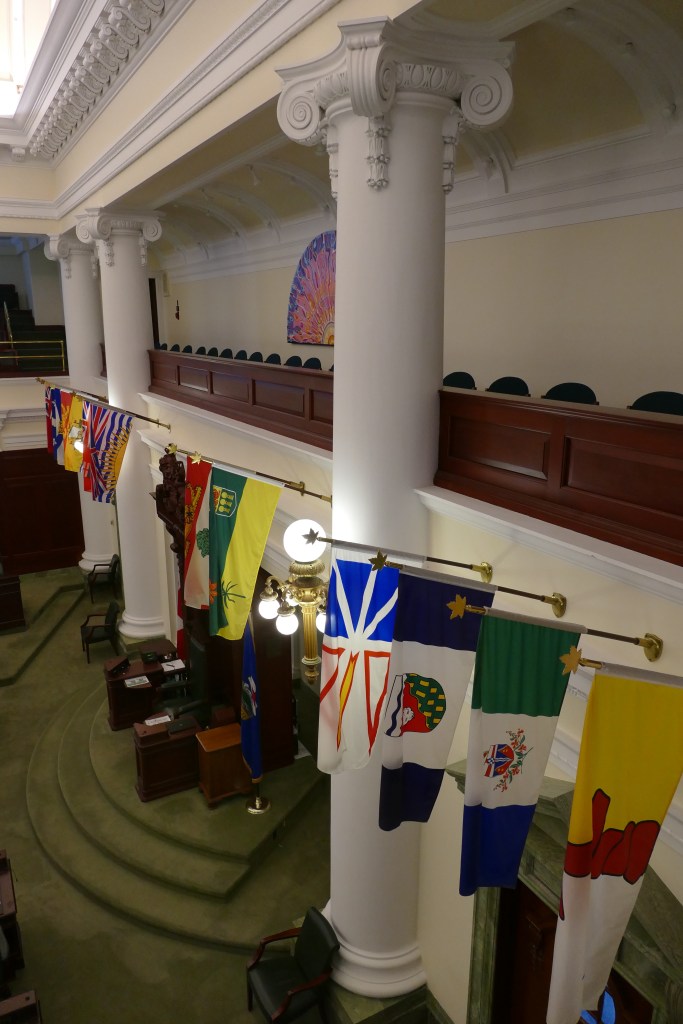
The Chambers of the Legislature. The Speaker sits in the large chair on the right. The press is assigned seats in the section above the speakers chair.
Special guests sit in the small section on the upper left, and the general public is allowed to sit in the section above the legislators. We were in an area similar to the public viewing area, but it is for guests of the legislators.
Per our tour guide, Alberta is the only legislature that displays the flags of all 10 Provinces and 3 Territories in Canada.
After we saw the chambers, a very excited security guard came up to our tour group. I was thinking something was wrong, based on the expression on her face. But she announced that we were invited in to see the Premier’s office. The current Premier of Alberta is Jason Kenney. The woman leading our tour group asked her multiple times if she was sure, and then she became excited as well.
Apparently this area is strictly off limits, and both the tour guide and security guard said they have never, ever, been “past that door.” It turns out a young man that works behind “that door” happened to be working on the holiday, saw our tour group, and invited us in. Yea! So we had a quick “bonus tour.”
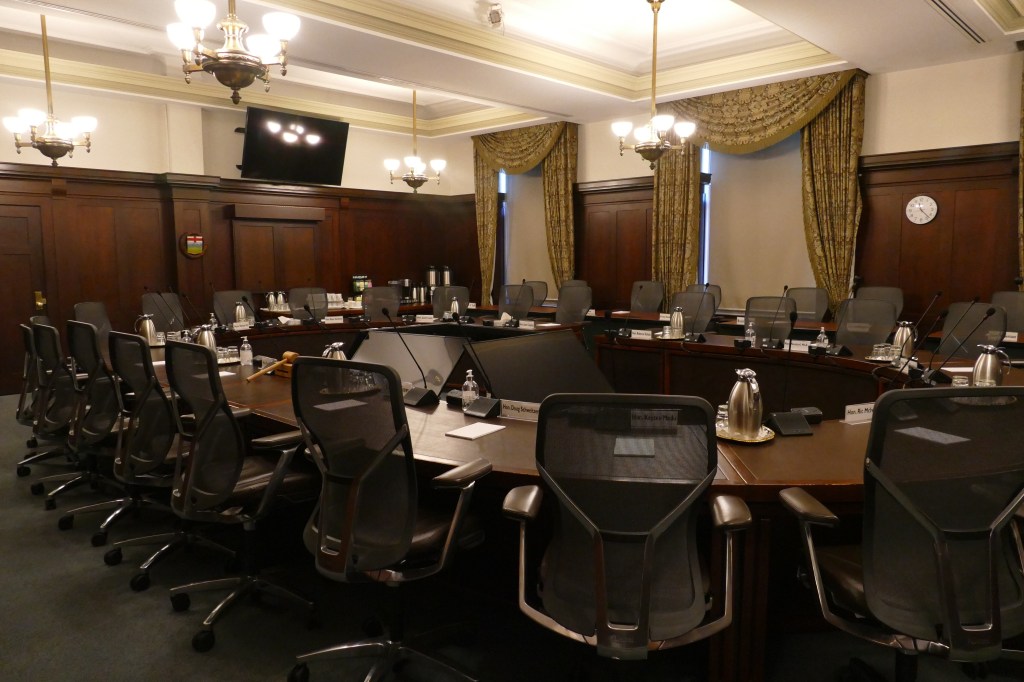
First stop was the Cabinet Room, where the Premier meets with the Cabinet Ministers, as they are called in Canada.
Then we entered the Premier’s office.
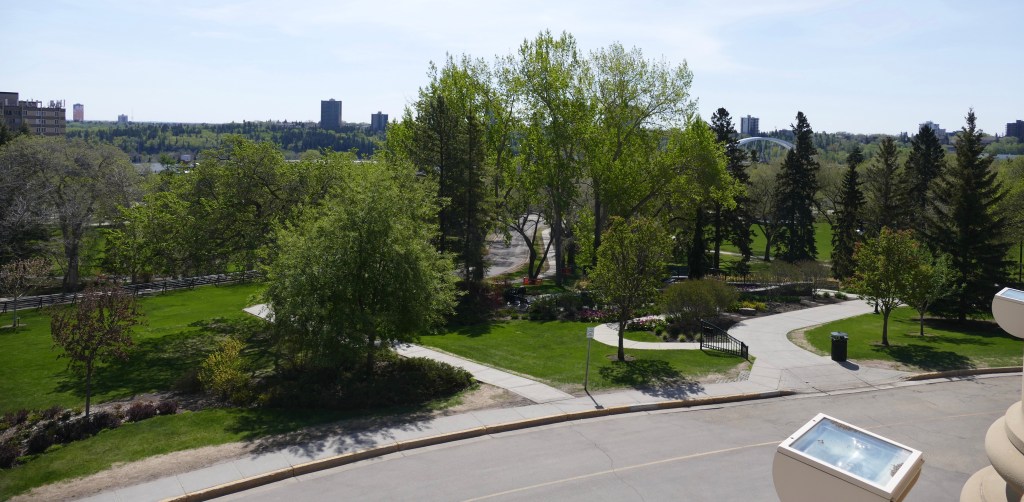
There is a nice balcony off the office, with views of downtown Edmonton.
And this is the hallway behind “that door” containing offices of the staff that work for the Premier.
Fun Fact: The province of Alberta was named after Princess Louise Caroline Alberta, Queen Victoria’s daughter. Princess Louise wanted the province named “Louiseland” but the legislators overruled her, and used her last name of Alberta instead.
After the tour ended, I watched our tour guide excitedly tell some of the other tour guides about being invited to see the Premier’s office. They were all amazed. So I guess it was a really big deal!
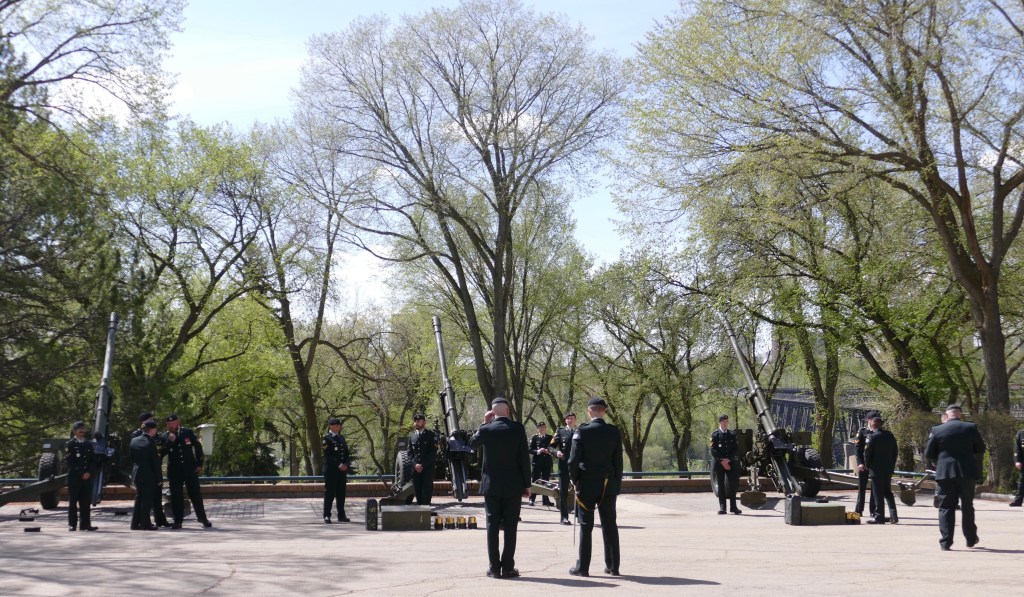
There is a large expanse of lawn outside the building, and we noticed a small marching band assembly, and some members of the military were setting up some cannons. I asked our tour guide what was going on, and she stated there would be a ceremony at noon, in honor of Victoria Day. So we decided to stay for that. The marching band only had about 100 yards to march from the parking lot, and they played the Canadian National Anthem along with God Save the Queen.
Before the firing started, we were told to stand about 75 yards away from the cannons. It was loud! First time we have ever witnessed something like that.
I took a lot of photos, and was able capture the explosion below.
It created a lot of smoke, and it was not a windy day, so the smoke lingered.
Eventually, you couldn’t even see the cannons.
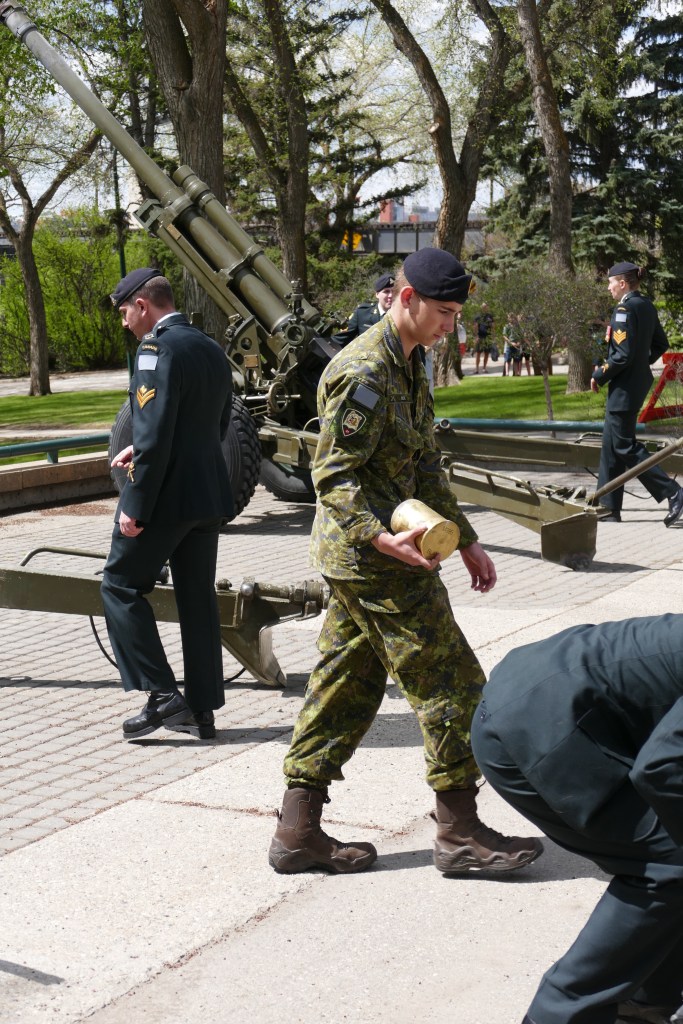
Once the ceremony was done, the soldiers stood at attention until they were dismissed and took apart the cannons.
Picking up the empty shells
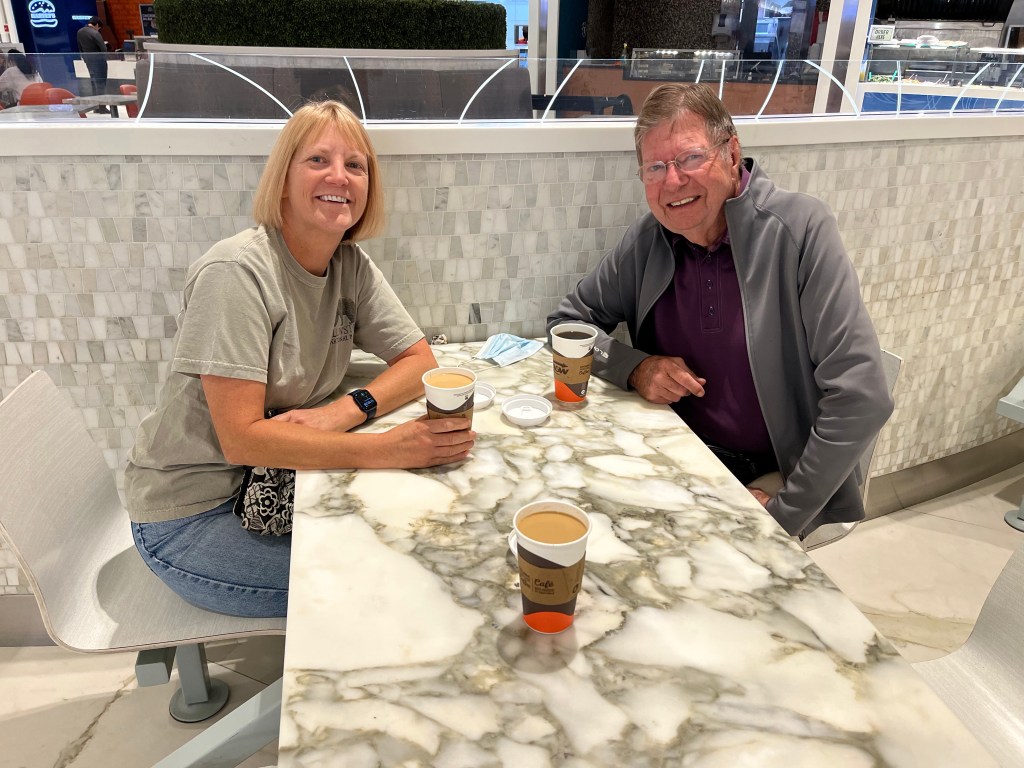
While we were in Edmonton, we met with our friend Lyle, at Edmonton Mall. Lyle is one of the many wonderful Canadian friends we have met in our RV park in Yuma. It was nice catching up with him, as he opted to go to Mexico instead of Yuma this past winter.
Quote of the Day: “Agreeable people are warm and friendly. They’re nice; they’re polite. You find a lot of them in Canada.” – Adam Grant
Heritage Park is referred to as “Canada’s largest living history experience.” We happened to attend on opening day for the season of 2022, and the employees were excited to have everything fully opened for the first time in two summers. The park covers the history of Canada from the mid-1800s to the 1930s. Covering over 127 acres, there is a lot to see and do for all ages. Plan on a lot of walking! As I previously blogged on, this park also contains the excellent Gasoline Alley Museum. If possible, I would recommend doing the park and museum separately. We just had one day, and it can be done, but you will be exhausted. Here’s another blog post where I went crazy with photos.
The park pays tribute to Alberta’s “Famous 5” women that fought for equal rights for all women in Canada. Since this is a post about the park, if you want to read more about what the women accomplished, click on this link. The Alberta Five
The Famous 5 Centre of Canadian Women
Interior photos of the house, a replica of Nellie McClung’s Calgary residence from 1923 – 1932.
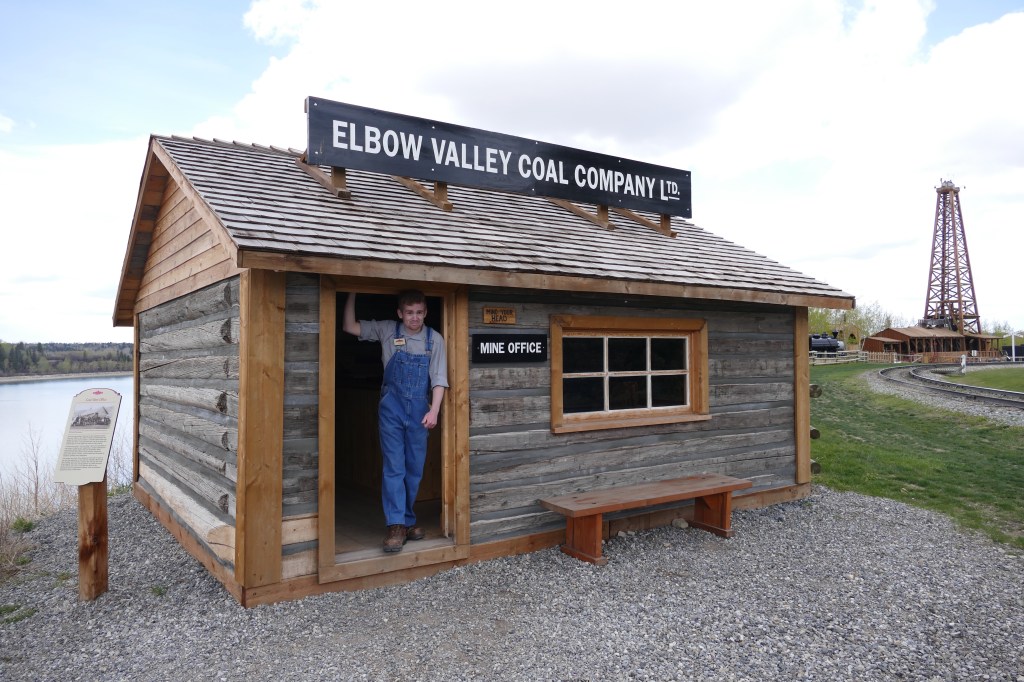
There is a section called “Prospect Ridge” that talks about the history of prospecting for gold, coal mining, and oil drilling.
Prospector’s “cabin”A working water wheel
They have a “mini” replica of a coal mine that you can walk in.
In 1911 oil was discovered by W. S. Herron in southern Alberta. He started the Calgary Petroleum Products Company with A.W. Dingman. This is a reproduction of Dingman No. 1 Discovery Well.
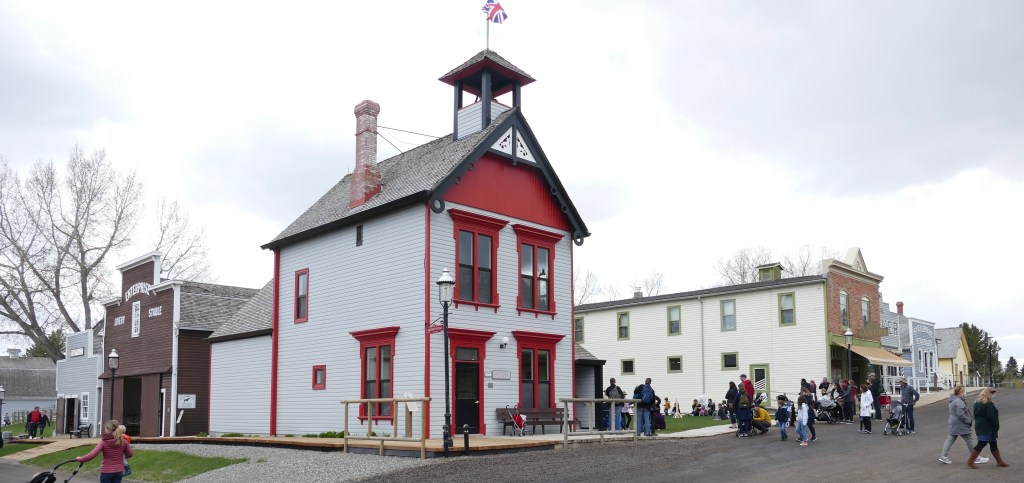
Village Centre, circa 1910
The park has reproductions of buildings replicating life in the early 1900’s, with houses, drugstore, hotel, bakery, newspaper, post office, general stores, saloon and more. The buildings are open to tour and staffed by docents in period costumes explaining the history of the building.
Calgary Town Hall
The post office was not only the place to send and receive mail, but it served as the phone company as well. The postmaster knew all the gossip in town!
The phone company
This structure is all that remains from the barracks of the Royal Northwest Mounted Police (which eventually became the Royal Canadian Mounted Police in 1920) in Banff.
Wainwright Hotel and Bar Room circa 1907
The Strathmore and Bow Valley Standard newspaper was founded in 1909. It was a weekly paper. Back in the day, the owner did everything from reporting to printing the paper. It was a very labor intensive process.
Printing press
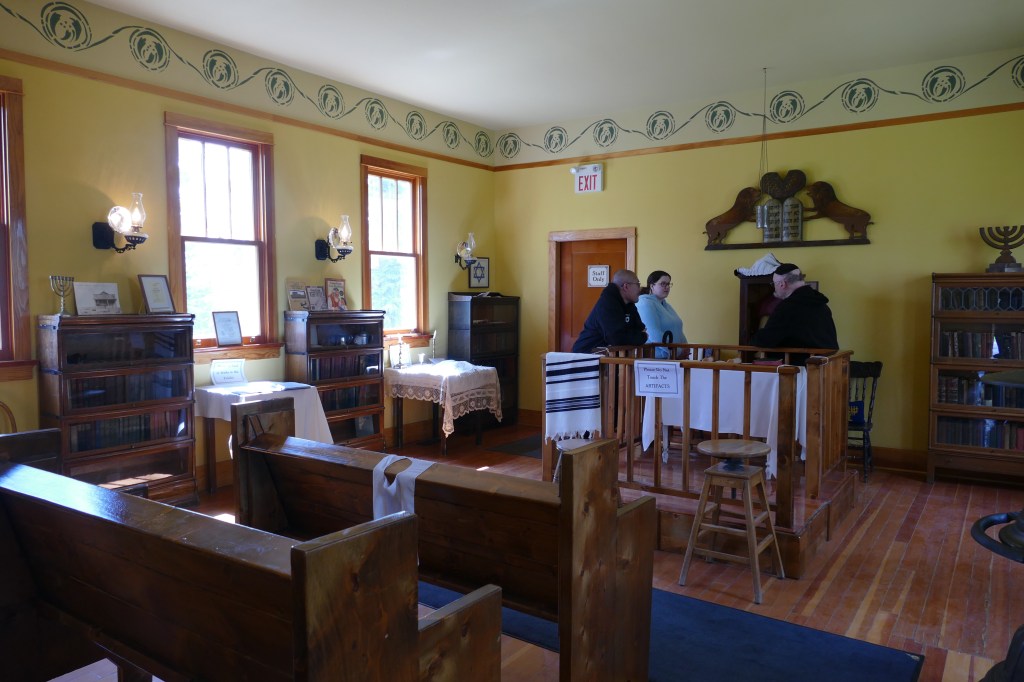
The Montefiore Institute Synagogue was one of eleven Jewish farm colonies established across Canadian prairies between 1887 and 1914. This is a rare surviving example of a prairie synagogue that has been fully restored.
Interior of the synagogue
What’s a town without a bakery? This was a very popular stop, with fresh loaves of baked bread, cookies and cinnamon rolls. If you look close at the picture below, Karen and Al are sitting on the bench next door, with Dan in front of them, enjoying some freshly baked goods. The building they are sitting at is Baron’s Snooker, which contained a barber shop and snooker tables.
Alberta Bakery Barber shop
Snooker tables are similar to pool, but are considerably larger at 12 x 6 feet.
Snooker tables
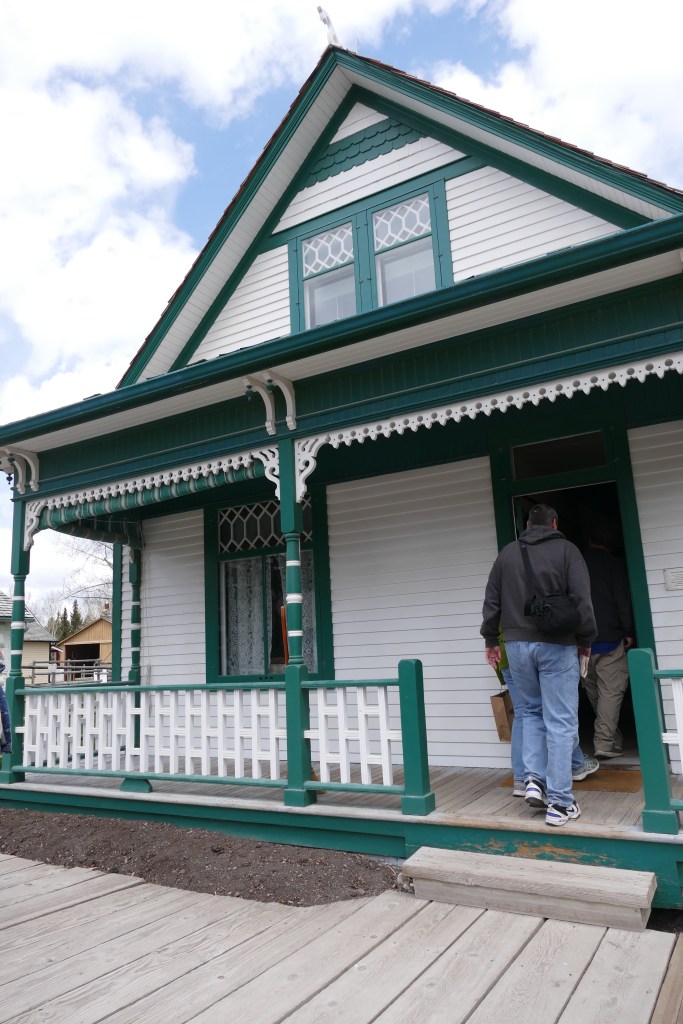
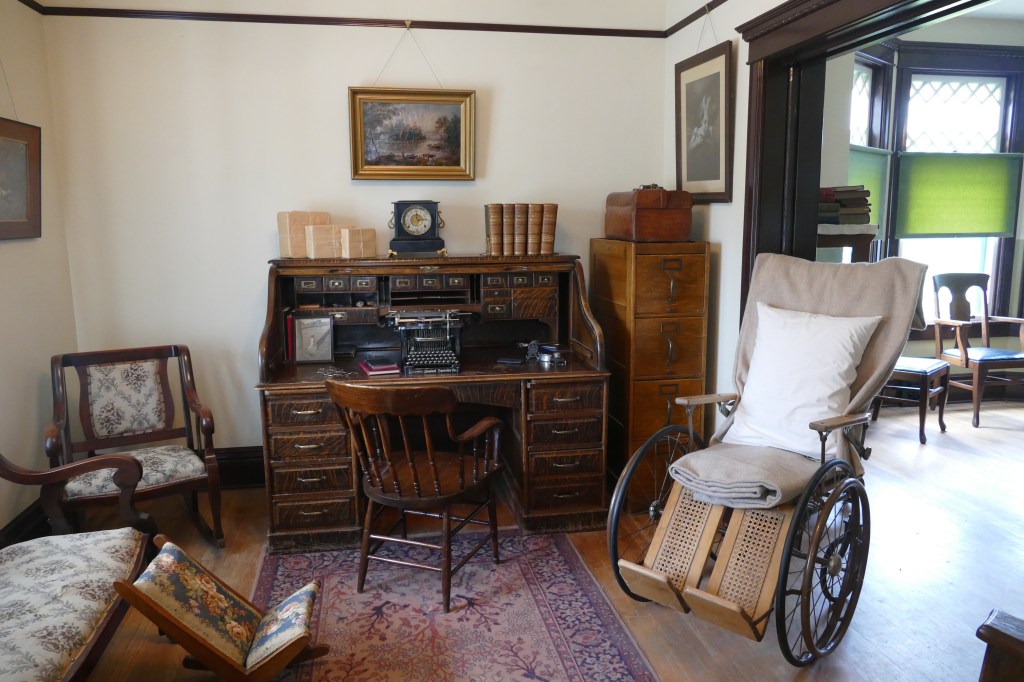
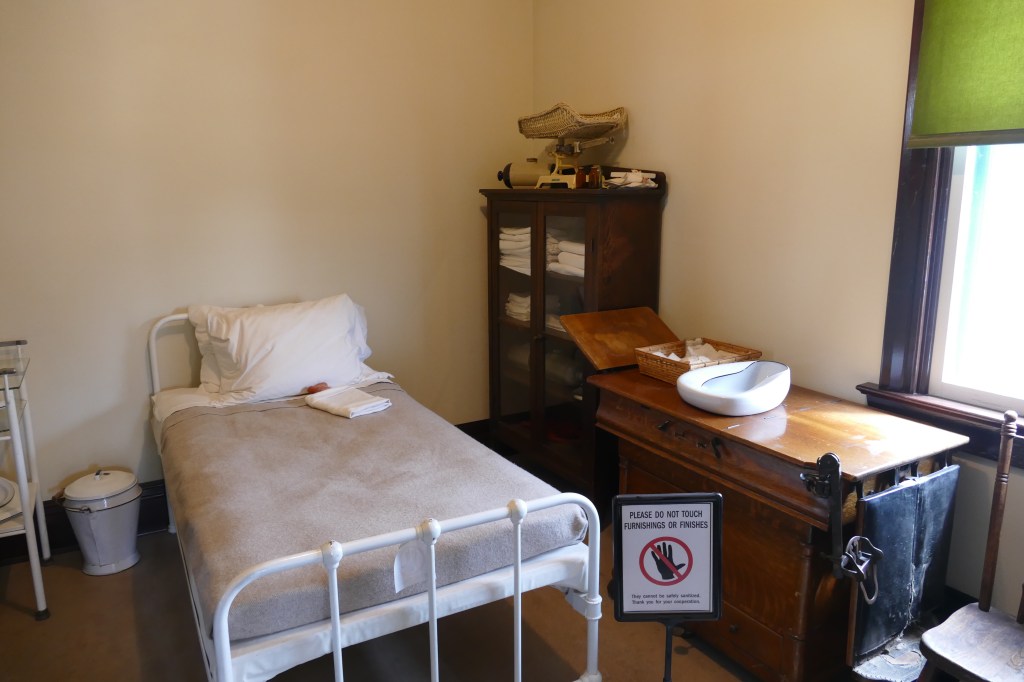
This house, built in 1907, has been restored to represent a Cottage Hospital.
The nurse is demonstrating the instruments and techniques used.
Doctors officeHospital room
St Martin’s Church, constructed in 1896.
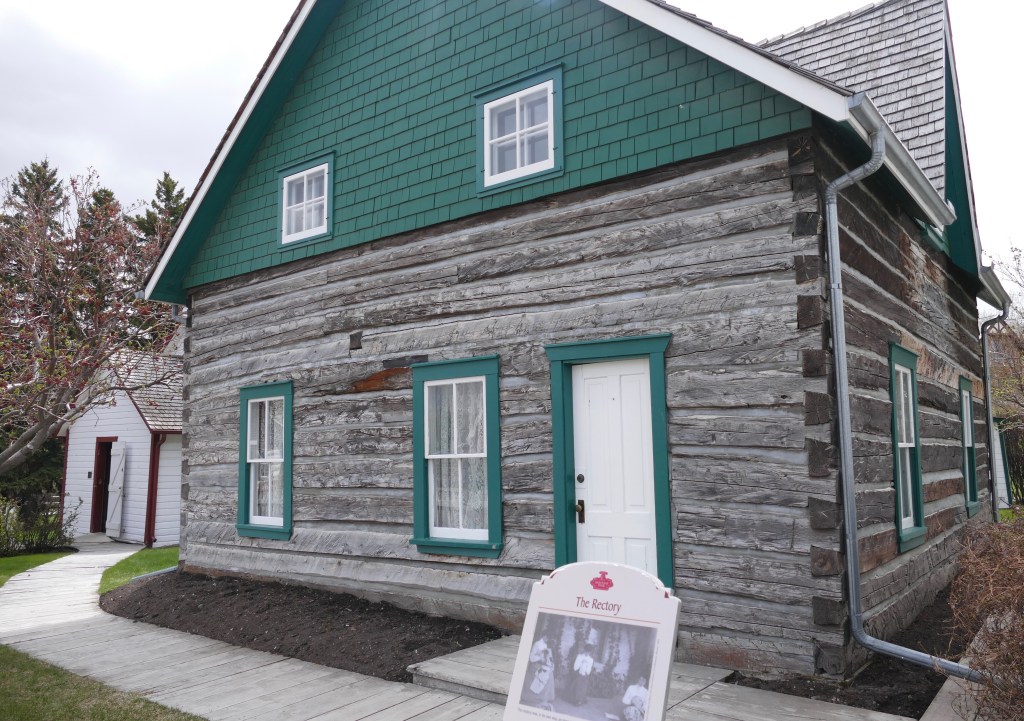
The Rectory
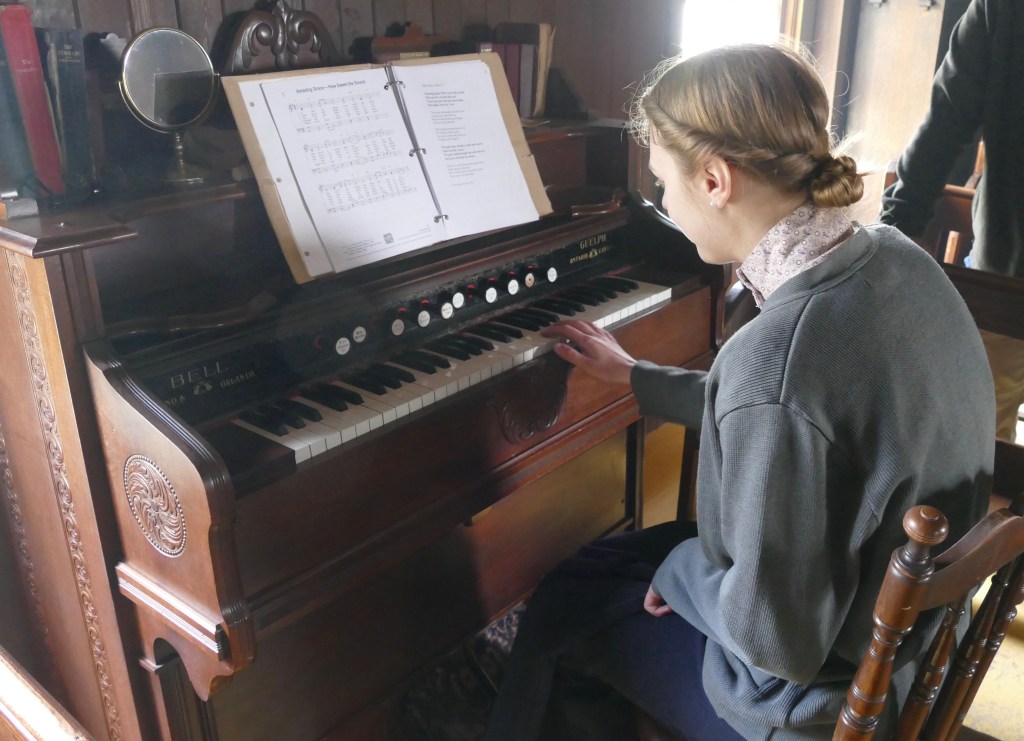
Interior of St Martin’s Church.
The docent played a few hymns on this church organ.
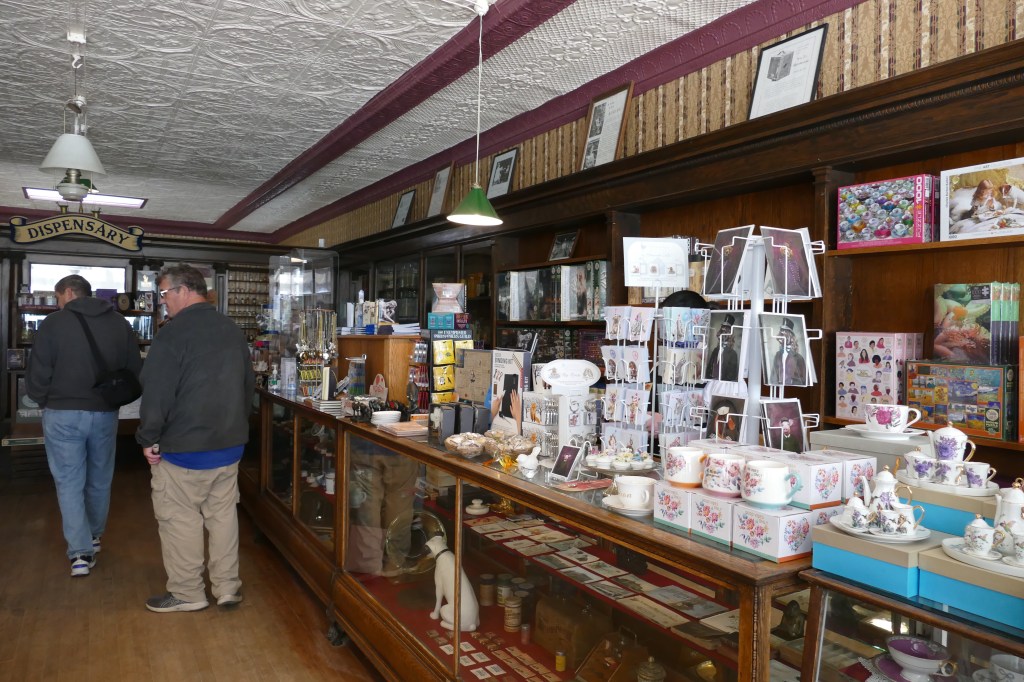
Gledhill’s Drugstore, built in Dundurn Saskatchewan in 1908. Pharmacists would set up shop in small communities to dispense medicinal powers and alcohol-based elixirs. In addition to providing basic medical advice, they administered first aid, pulled teeth and treated livestock. Since they earned little money from the drugs, they would sell toiletries, candy and basic supplies to supplement their income.
Lots of “remedies”Pharmacist/Apprentice wanted $6/week!Dan and Al shopping in the drug store
Wait, is there a dog in the display case in the above photo? It looks like it could be one of Makena’s relatives!
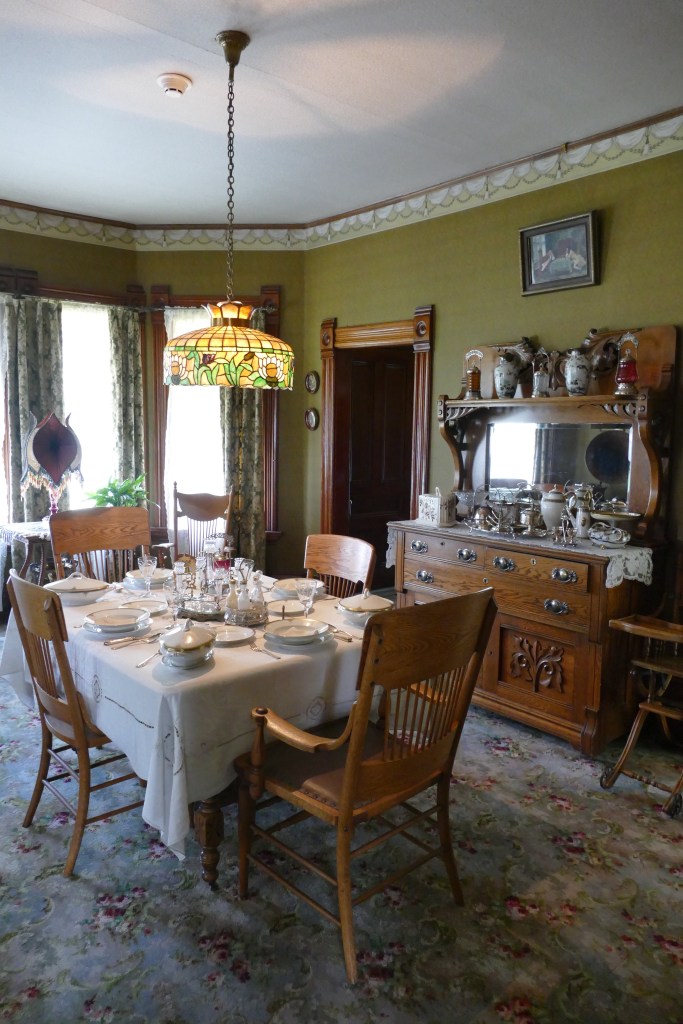
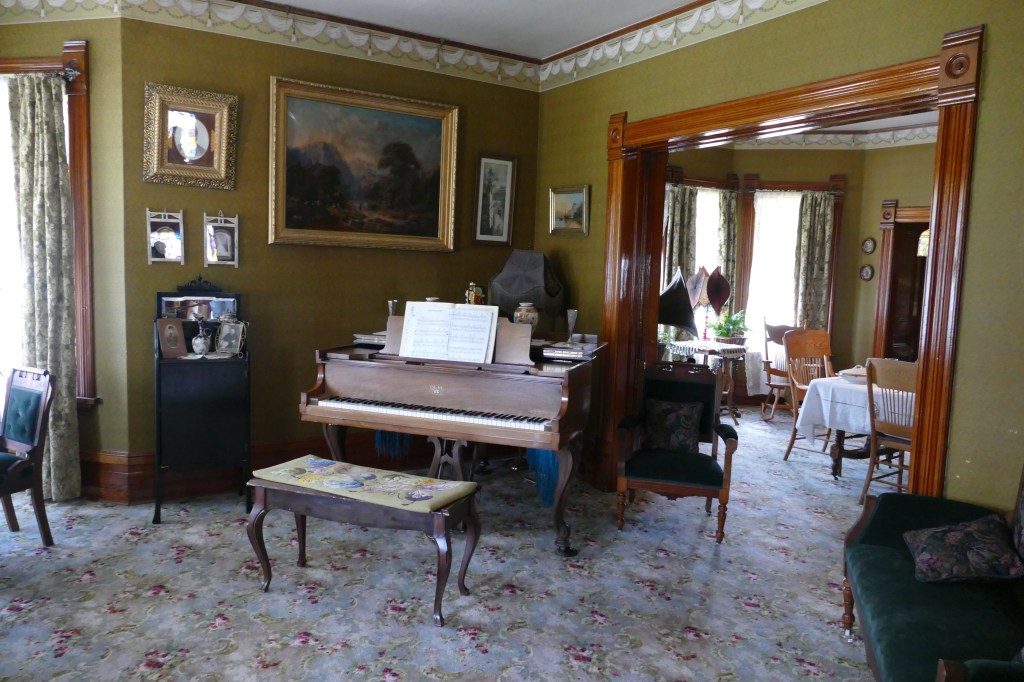
Peter Prince relocated from Quebec to Calgary in 1886 as manager of Wisconsin based Eau Claire and Bow Valley Lumber Company. In 1894, the very wealthy Mr Prince built this 3300 square foot home, with eight bedrooms and modern utilities.
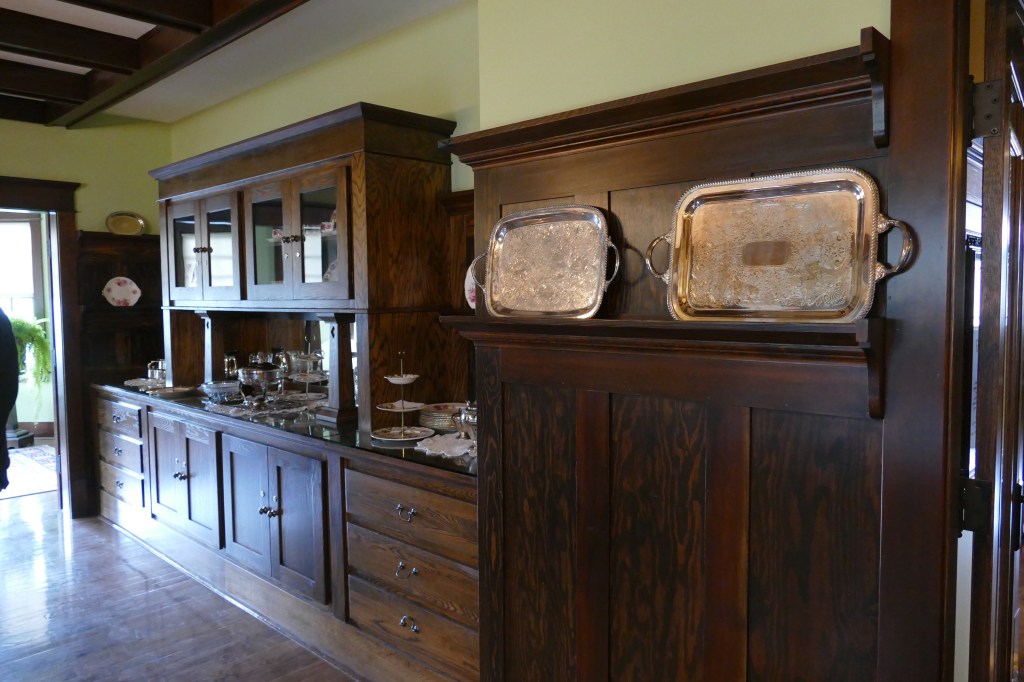
Prince HouseDining roomParlor
The Burnside Ranch House, where one of the docents was preparing lunch for other volunteers. They have gardens, chickens, and pigs in the park, and try to live off the land, just as they did a century ago.
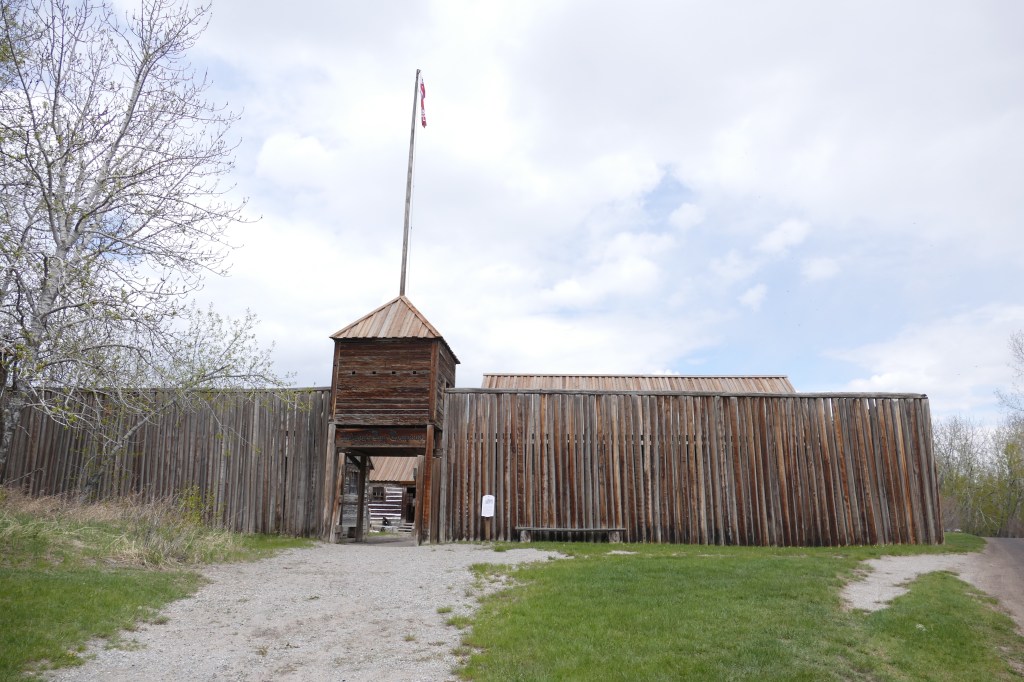
Fully working stoveHudson’s Bay Company Fur Trading Fort Circa 1860
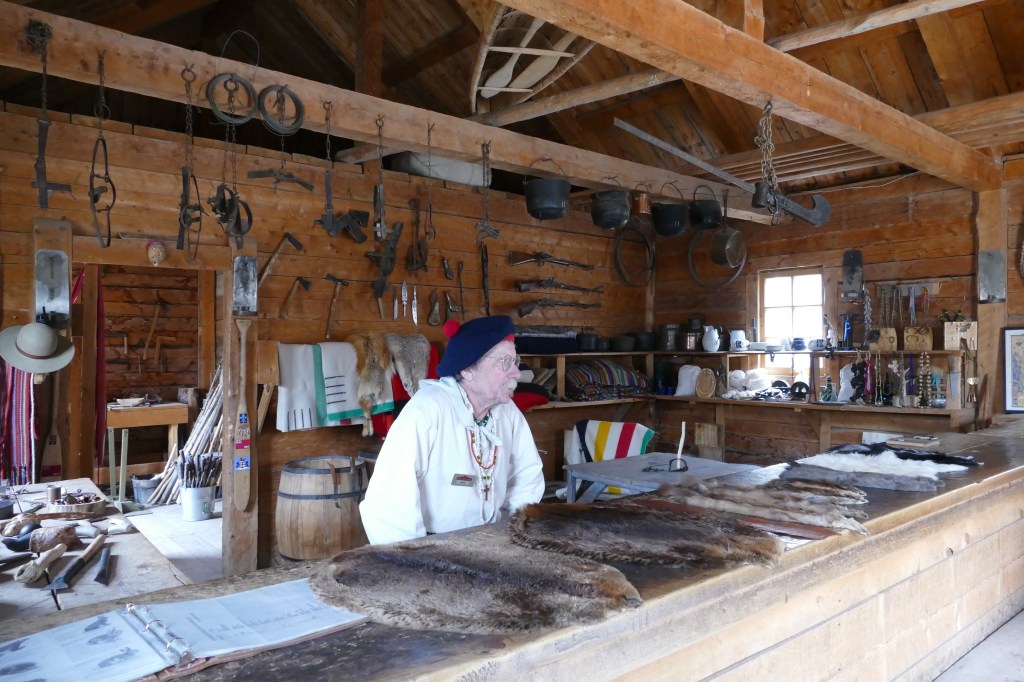
This docent gave a very detailed discussion on the history of fur trading and the values of various pelts. Beaver pelts were highly valued.
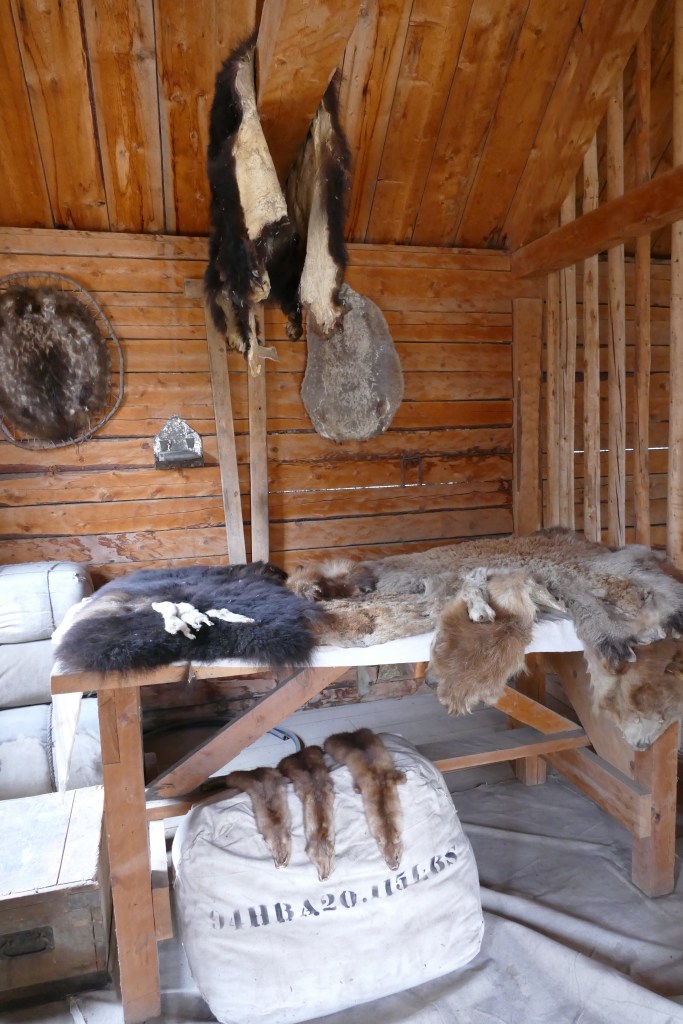
Furs for sale
Heritage Park was a lot of fun to visit (and a good way to get a lot of steps in!).
Quote of the Day: “A people without the knowledge of their past history, origin and culture is like a tree without roots.” – Marcus Garvey
Gasoline Alley Museum located at Heritage Park in Calgary, Alberta, is a “must see” if you are in the area. This museum is open year round. The historical village portion of Heritage Park is open mid-May to October. I will do a separate post on the historical village portion of the park. This post contains a lot of photos, so it may take some time to load if you have internet issues.
The museum contains antique cars, trucks, gas pumps and signage from petroleum companies. All of the items were donated from a local businessman, Ron Carey. In talking with one of the docents working in the museum, they received about 1/3 of his collection of vehicles. He also stated they believe the museum houses the largest collection of gas pumps in Canada.
Our friends that we are traveling with, Karen and Al Phillips, found the ”Phillips” gas pump.
The green vehicle on the right is a 1937 Terraplane “Big Boy” Pickup, featuring a waterfall grill. A 1912 Buick Model 2-A Express Truck is to the left.
The rear view of the trucks.
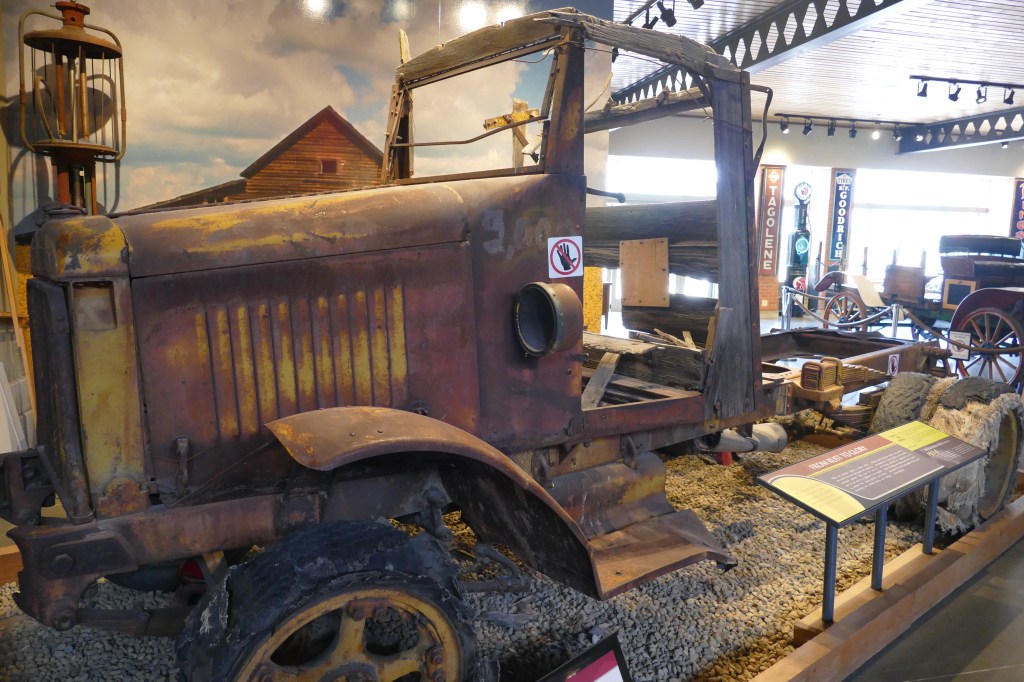
This is a 1924 unrestored International Truck that was found rusting away on a farm. It has been left as they found it.
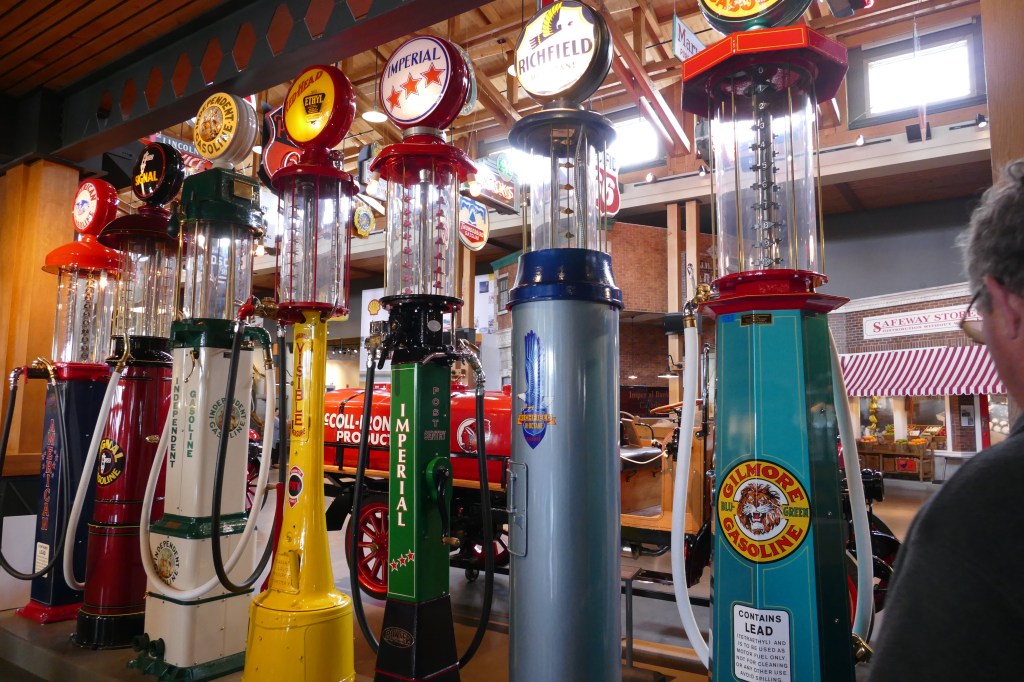
The first outdoor gasoline pump was invented by Sylvanus Bowser. In 1905, the “Bowser Self-Measuring Gasoline Storage Pump,” a metal tank inside a wooden cabinet with a flexible hose and manual suction pump, was put into service. The Shell tank below is a model from 1911.
1911 pump with 1950s model in rear
The first pumps were called “pre-visible pumps” since customers could not see what they were buying.
In 1915, “visible pumps” were invented. Gas was pumped from an underground storage tank into the “visible” glass tank, so customers could see what and how much they were buying. Apparently people felt they were getting cheated by the gas companies, so this solved the problem. 100 plus years later, people still feel cheated by the gas companies!
Visible pumps
Clock-faced pumps began appearing in the 1920’s that were faster and more accurate than the visible pumps. A bell rang with every gallon dispensed, and the dial would show the total amount pumped.
Clock-faced pumps
In 1934, the computer pump was invented. It would “compute” the total sale in dollars and gallons.
Computer pumps
A rare, fully restored 1926 Shell Tanker fuel delivery truck with a 500-gallon fuel tank and 12 5-gallon fuel cans.
1919 Oldsmobile 3/4 Ton Truck. Trucks like these were very popular with farmers and delivery companies.
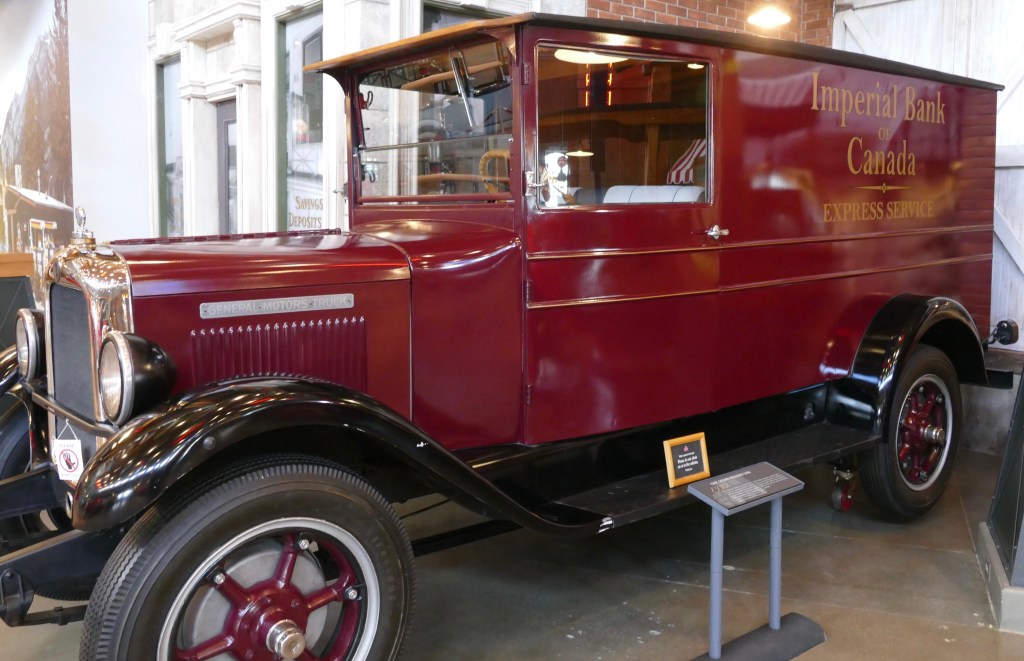
1927 GMC Sedan Delivery Vehicle. The Imperial Bank of Canada had a fleet of maroon vehicles. This one was used to deliver packages.
1956 Plymouth Sport Suburban Station Wagon. The lighting doesn’t really show how bright pink this vehicle is. I think every person walking by said “wow, that’s really pink!”
1931 L-29 Cord, a popular front-wheel drive car.
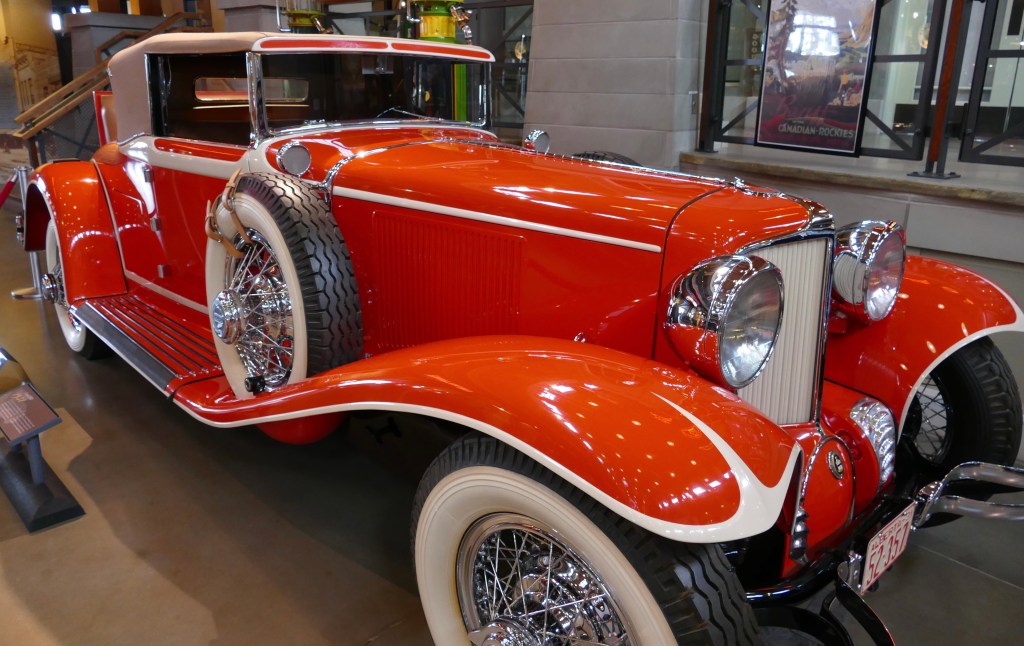
1932 Auburn with a 6.4-liter V12 engine.
1905 Cadillac, found in an abandoned gold mine in Northern California. It was likely a Model E Runabout that was converted by a prospector into a truck. It has been preserved to the condition it was found in.
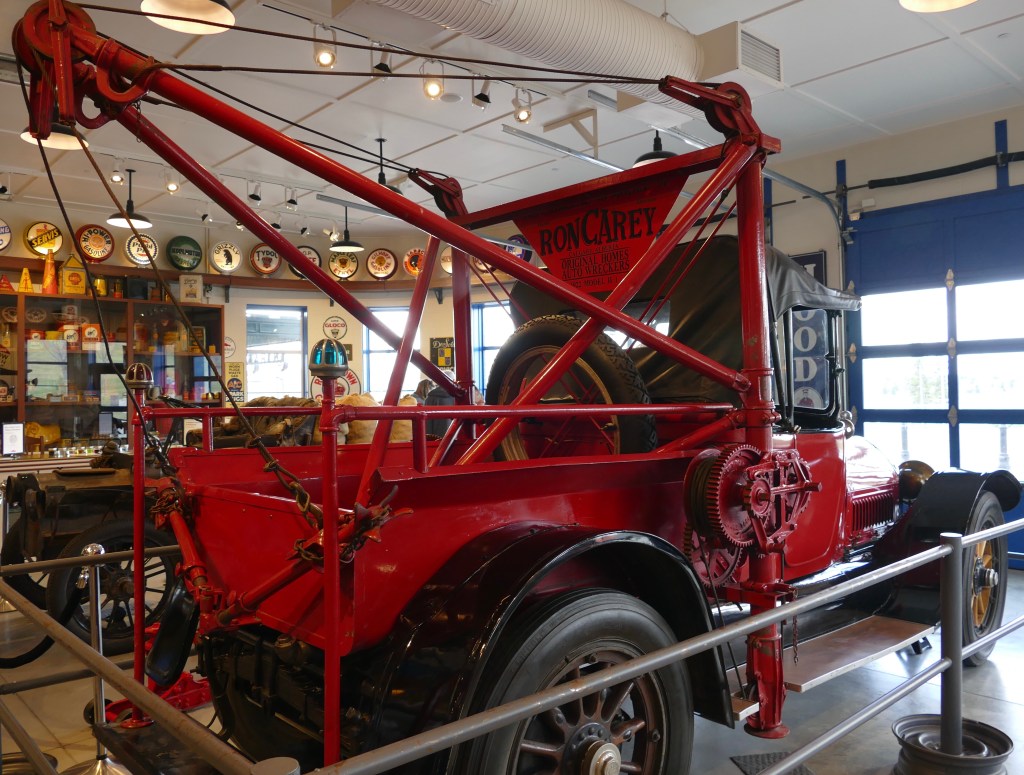
Front and rear photos of a 1915 Cadillac that was retrofitted in 1922 as a tow truck.
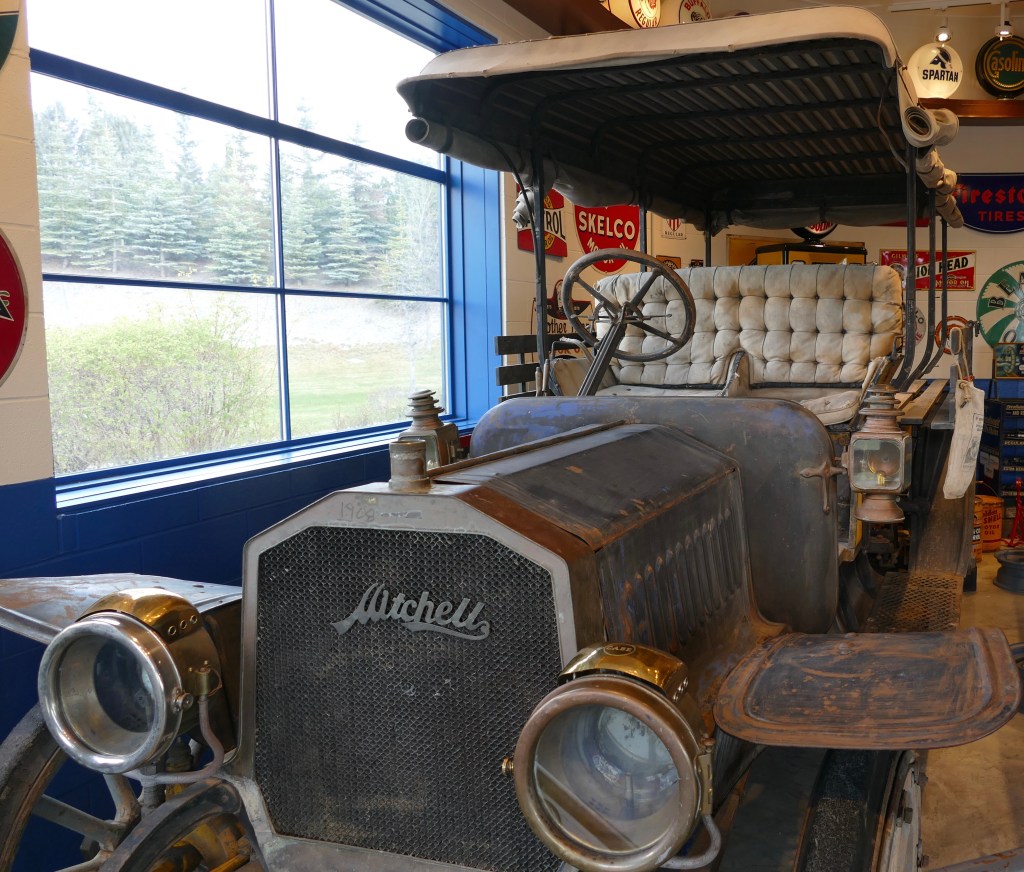
A 1908 Mitchell. The MItchell Motor Car Company was located in Racine, Wisconsin. We are both from Wisconsin, but I had never heard of the company until I saw this vehicle.
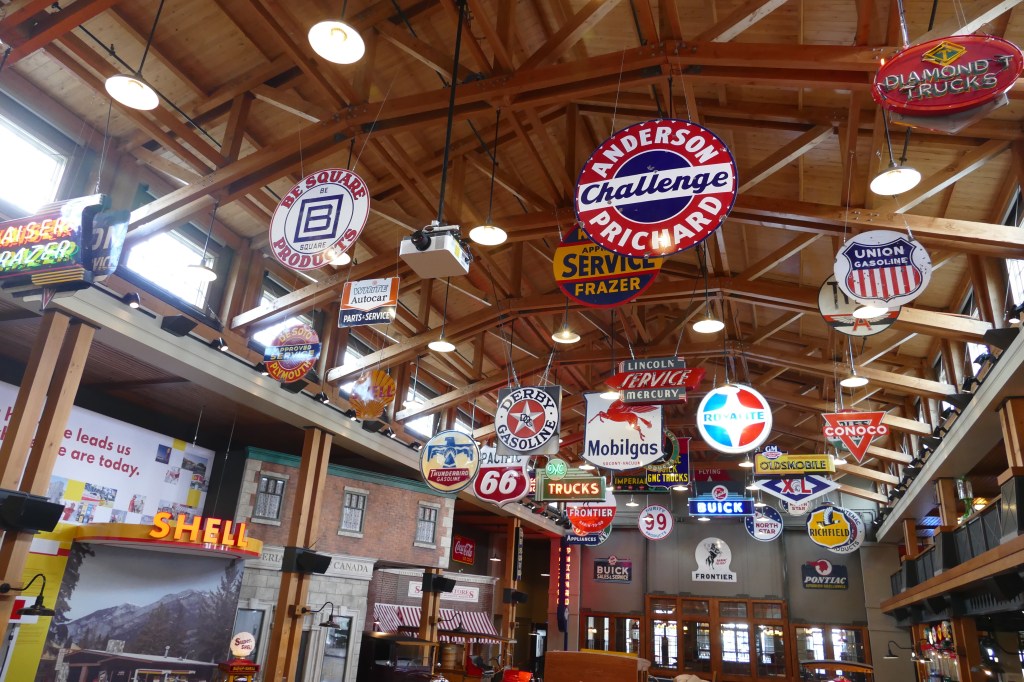
The museum has an extensive collection of signs.
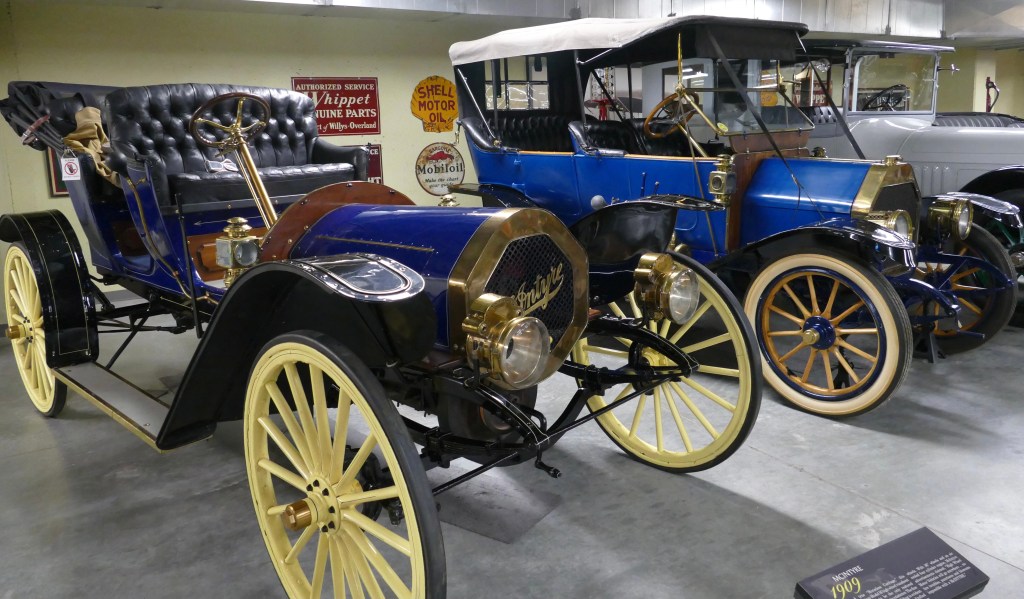
Below, on the left is a 1909 McIntyre Model M high wheel runabout. A 1911 Model 49 Overland is on the right.
On the left is a 1918 Chevrolet 490 (named for it’s selling price of $490). It was designed to compete with the Ford Model T. The maroon vehicle is a 1922 Gray-Dort Model 19-B, produced in Chatham, Ontario.
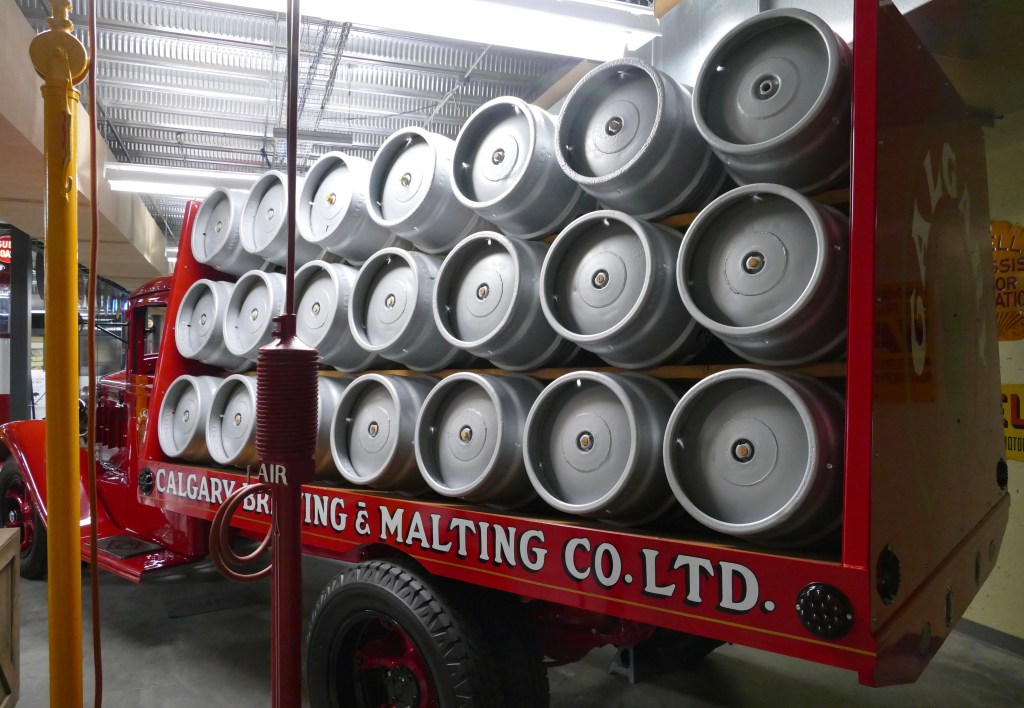
Two photos of a 1933 Diamond T Brewery Truck Model 210-FF. Diamond Ts were considered to be the ”Cadillac of Trucks” based on their performance and construction.
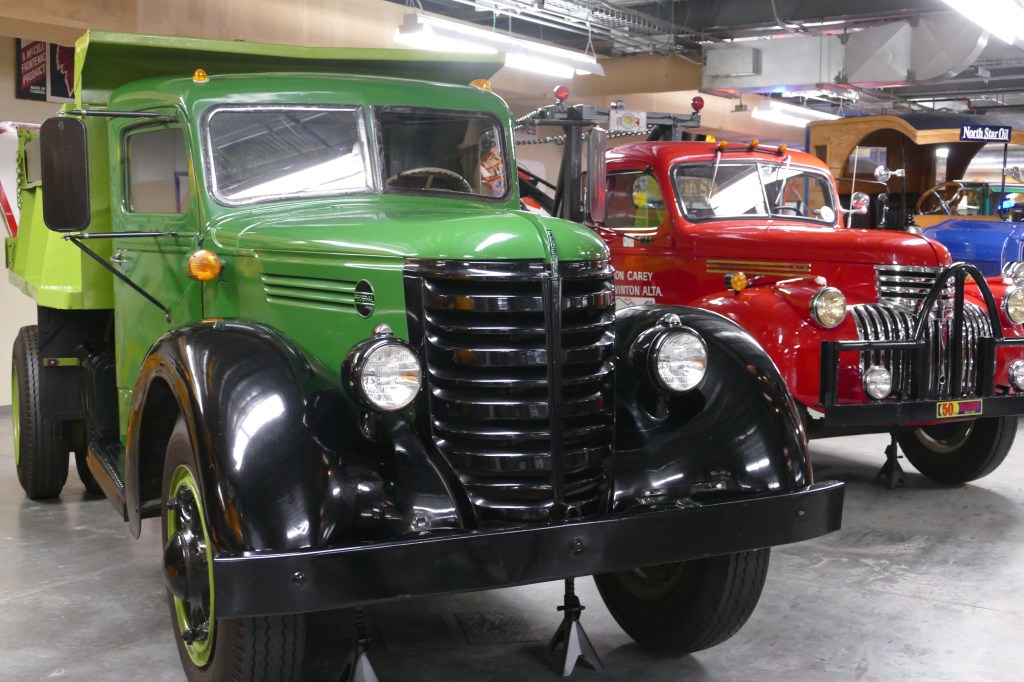
The green vehicle is a 1945 Federal Dump Truck that could hall four yards. The red vehicle is a 1941 Chevrolet 1 1/2 ton Tow Truck.
A rare 1949 Endor Pixie Motorized Bicycle, with a two speed gearshift on the left handlebar and a twist grip throttle on the right. It had a top speed of 26 mph.
Front and rear photos of a 1928 Ford AR Roadster Pickup. This was a Canadian built model, because both the driver and passenger doors open. Fords built in the US had no drivers door that opened, to prevent drivers from stepping out and into traffic. In Canada, some provinces drove on the right, and some on the left, up until the 1940s. So two functional doors were needed.
This was just a wonderful museum. There is such a variety of vehicles on display, in various conditions. My photos are only a fraction of what they have on display here. If you are in the Calgary area, make sure to stop in – you won’t regret it.
Quote of the Day: “The best car safety device is a rear-view mirror with a cop in it.” – Dudley Moore
While we were waiting to cross the border into Canada on May 17, 2022 , we recorded the mileage on our motorhome at 10,925 miles. We have driven 902 miles from May 17 to the 31st, and have purchased 433.47 liters of gasoline, which equals 114.50 gallons. Total cost for fuel on the motorhome since crossing the border May 17th was $585.60. This works out to an average of $5.11/gallon. And this was all in the Province of Alberta. Where gas is cheap! Alberta prices ranged from 1.69/liter to 1.769/liter. Per our friend Don, gas is well regulated here, so you don’t get the wild price swings like in the US. One gallon of gas equals 3.78 liters (it’s all about the math!). We are now in British Columbia, and gas is over $2/liter.
May campground and entertainment costs
We had 15 nights of camping in Canada in May, at a total cost of $510.98 American, which works out to $34.07 per night. We have had full hookups (water/sewer/electric) and places with just electric (and the electric is 30 amps). There are many options to choose from, so your campground costs will vary. Don’t plan on having much for wi-fi! Even the campgrounds that advertise internet – it’s not always usable. (I’m currently writing this at 4:30 am – that’s when I can get on the campgrounds free wi-fi. It’s been light outside for about 45 minutes, so if feels more like 6 am.) We don’t have a satellite dish, and have always relied on over the air for television. We have not been able to pick up anything over the air, so if that is something that is important to you, pack a lot of DVD’s!
We have visited many museums and toured the local towns. Entertainment costs will vary based on your own personal interests. We have spent a total of $97.00 since May 17th on museums and sightseeing adventures. These are in American dollars. Right now, $1 Canadian equals 78 cents American, so we use our credit card as much as possible to get the more favorable exchange rate.
Prices in the grocery stores are comparable to costs in the United States for most products. Dairy and Canadian meat and chicken are a bit higher. Butter is sold by the pound (454 grams) but it is not divided into quarters like in the United States. I would have an issue with this for baking!
May Instagram posts
As promised, for those folks that are not on Instagram and/or don’t want to be on more social media sites, (thinking of you Ole!) I will have links to the posts that I made. So if you are interested in what else I have posted, just click on the links below. You can go through the photos on the posts by swiping to the left on the pictures. Given the limited internet, I will continue to use Instagram for quick updates on where we are. Instagram will always be the most current way to keep up. For more detailed posts on some of the places we have visited, I will continue to do blogs (although I need to stop taking so many photos!). I still have several more blogs to post on some more museums from May, so stay tuned.
If for some reason the links are not working, or you have any issues, please let me know at liv2rv@gmail.com
Located in Calgary, Alberta, is The Military Museums (yes, plural). The building complex contains museums honoring the Air Force, Navy and Army, along with various divisions within the Army. Plan on spending several hours here, as there is a lot to see.
Princess Patricia’s Canadian Light Infantry (PPCLI)
Established in 1914 during World War I, the PPCLI is one of Canada’s most famous regiments. It was named after Her Royal Highness Princess Patricia of Connaught, a granddaughter of Queen Victoria.
PPCLI soldier’s in WWI bunkerHandguns assigned to PPCLI soldiers
Below depicts PPCLI soldiers using the Lewis Gun, an anti-aircraft machine gun used during WWII.
The PPCLI not only served during WWI, WWII and Korea, but most recently in Afghanistan. They had on display LAV III “Charlie” which was used in 2008 in Afghanistan.
Canadian Women’s Army Corps (CWAC)
Almost 22,000 women were a part of the CWAC, and were stationed at Army bases in Canada and overseas. The women provided support services in transportation, medical and administrative areas. The museum pays tribute to their service. The CWAC was demobilized after WWII ended.
Royal Canadian Air Force (RCAF)
The RCAF was founded on April 1, 1924. The airman’s uniform was modeled after the Royal Air Force blue uniforms.
The museum has models of all the planes used by the Royal Canadian Air Force during WWII. It’s a model airplane lovers dream display.
A separate building held several airplanes used by the RCAF. A CF-104 Starfighter was on display.
There was a platform to view the cockpit of the Starfighter.
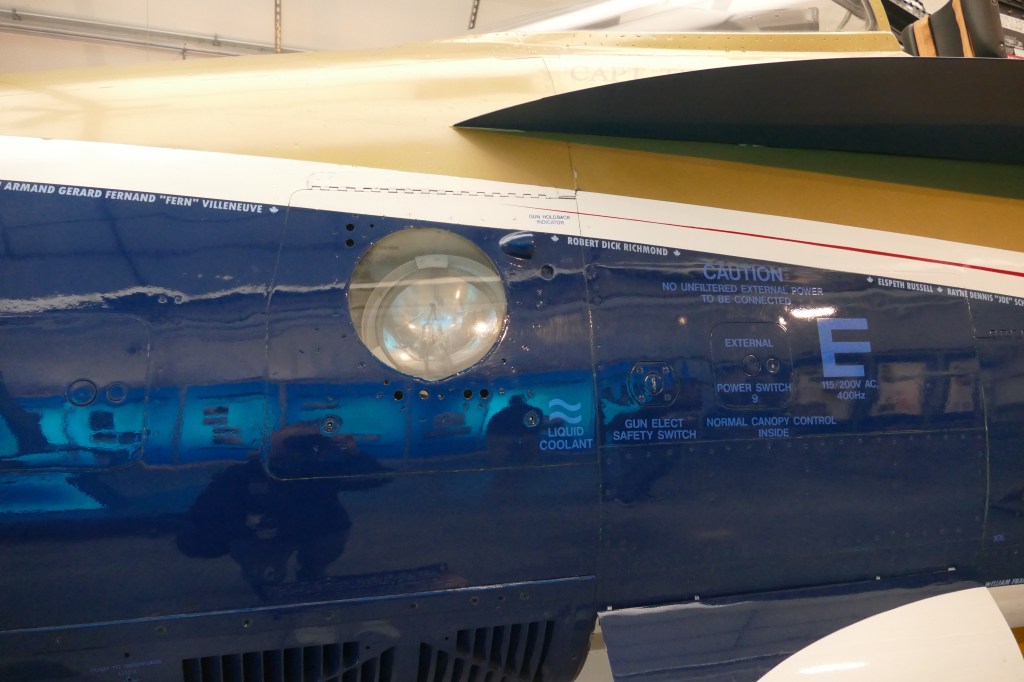
The museum also contained a CF-18 Hornet.
How do you tell the difference between a Canadian Hornet and an American version? The Canadian Hornet has a large light on the side by the cockpit. It is used for identifying aircraft in the darkness of the Canadian Artic.
Naval Museum
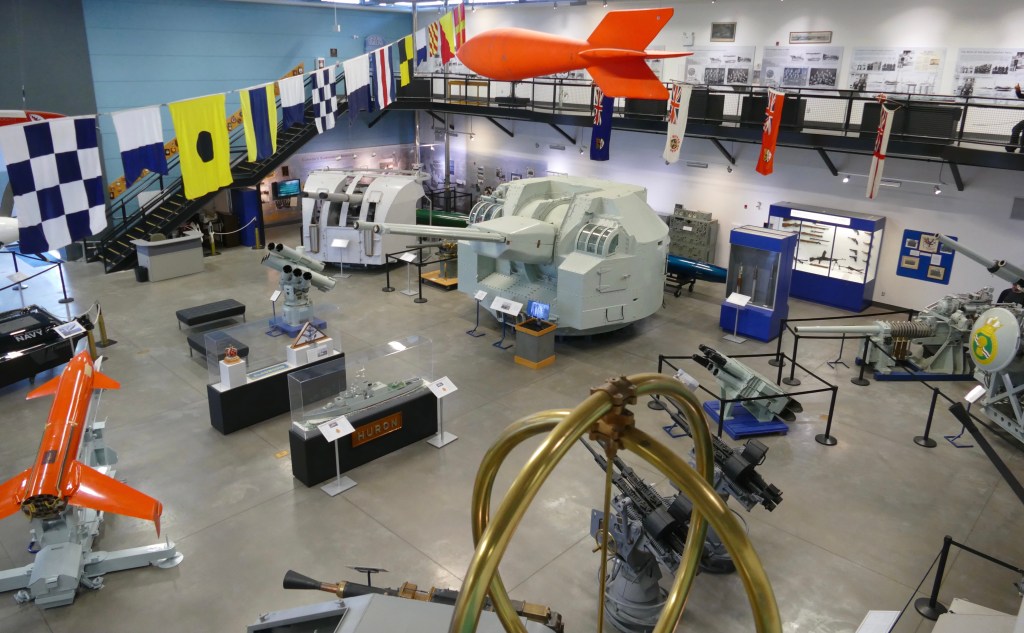
This was my favorite section of the museum, as they had a large display of aircraft, drone boat, uniforms, torpedos, various weaponry and models of ships past and present.
Among the many models of ships in the museum, is the HMS Bellerophon. This is the first Bellerophon, launched October 1786.
To the more modern day HMCS Calgary II. It is a Halifax Class Patrol Frigate, commissioned in 1995.
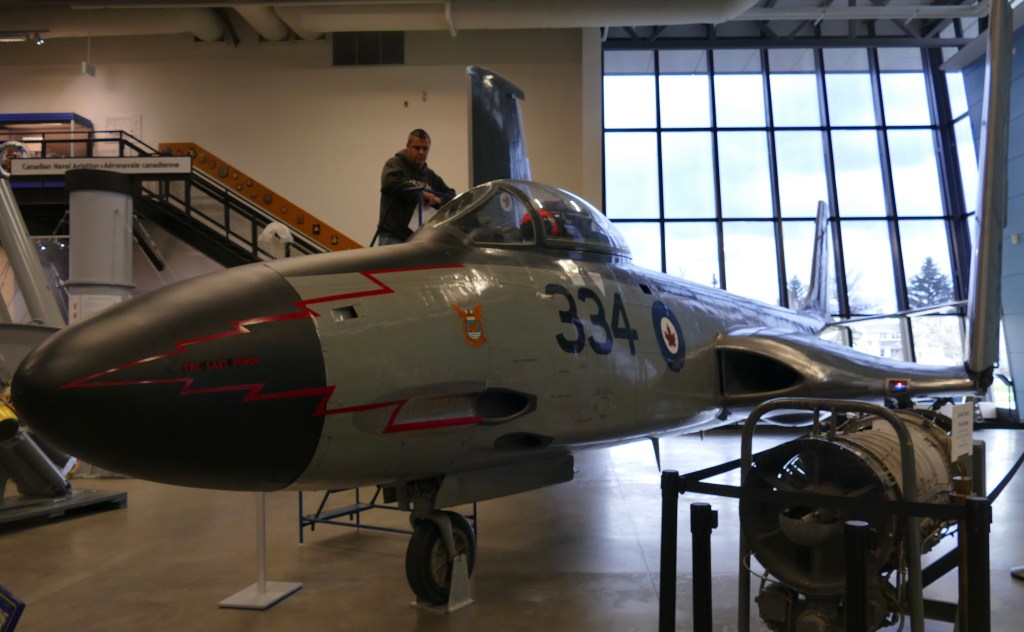
In 1955 Canada purchased 39 McDonnel F2H-3 Banshee planes. These planes were used until 1962 when the Royal Canadian Navy discontinued the use of fighter aircraft.
Hammerhead, a remote controlled small attack boat, with a maximum speed of 40 knots/74 km hour. Developed in Canada in 2008, it is still in use. It is the first time I have seen a “drone” boat.
This gun mounting was used for training at the West Coast Fleet School in Canada until 1995.
Ho, Ho, Ho and a Bottle of Rum!
The Royal Navy started the daily ration of rum to sailors around 1655. Rum was used as it kept better than beer in hot climates. Conditions were harsh on ships, and it was something the sailors looked forward to. The Canadian Navy followed the British and continued the tradition of rum rations until 1972. Below are various storage containers used for rum.
This copper set was used in WWII on HMCS Saguenay to measure out the daily issue of rum, about 2 5/8 ounces.
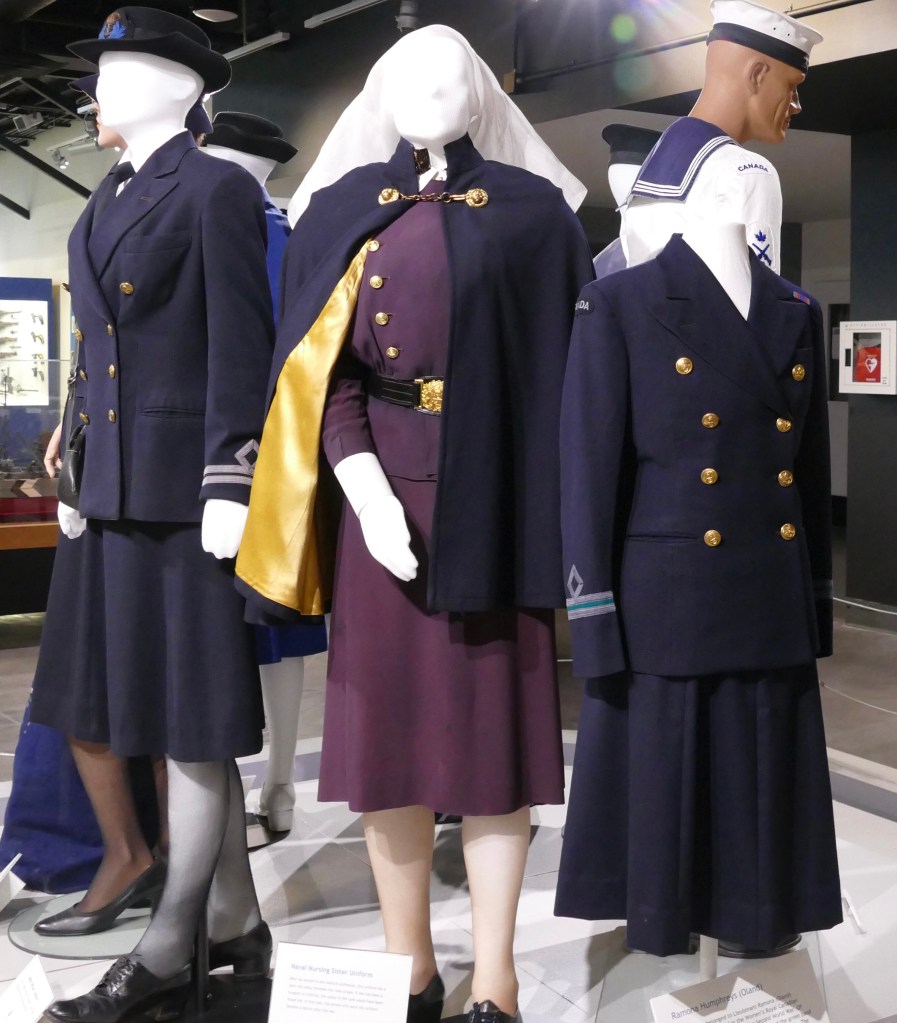
Naval Uniforms over the years
Enigma
The four-rotor Enigma machine was used by the German Navy in 1942 to securely transmit communications from Naval headquarters. The allies realized the only way to break the code was to capture an Enigma machine. The Royal Navy Destroyer HMS Griffon made the first capture of an Enigma machine and documents on April 26, 1940 from the German trawler Polaris off the coast of Norway. It has been suggested by post-war historians that intercepting and decoding German communications shortened the war and saved thousands of lives.
If you are in the Calgary area, we would highly recommend a visit to The Military Museums. My blog only covers a fraction of what they have on display. It is truly a remarkable place.
Quote of the Day: “We must never forget why we have and why we need our military. Our armed forces exist solely to ensure our nation is safe, so that each and every one of us can sleep soundly at night, knowing we have ‘guardians at the gate.’ ” – Allen West
Our first stop in Canada was in High River, Alberta. From there, we were able to visit several museums/parks within a 45 minute drive. I will have several blog posts on these museums over the next several days. For quick updates, I will use Instagram, as that works well with limited internet. For the more interesting things, or rather the touristy places that I take a lot of photos at, I will do a blog post, as Instagram is limited to 10 photos. Our Instagram page is liv2rv. https://www.instagram.com. Occasionally I may just post a blog with links to the IG pages, for those that are not on IG.
Located about 20 miles south of High River is The Bomber Command Museum of Canada https://www.bombercommandmuseum.ca. The museum commemorates those that served in the Bomber Command division during World War II.
The memorial wall contains the names of over 10,000 Canadian Bomber Command members that died in World War II.
During WWII the bombing forces of Canada were under British command to fight in Europe against the Nazi’s. The bombers suffered great losses during daylight raids, so they began operating almost exclusively at night.
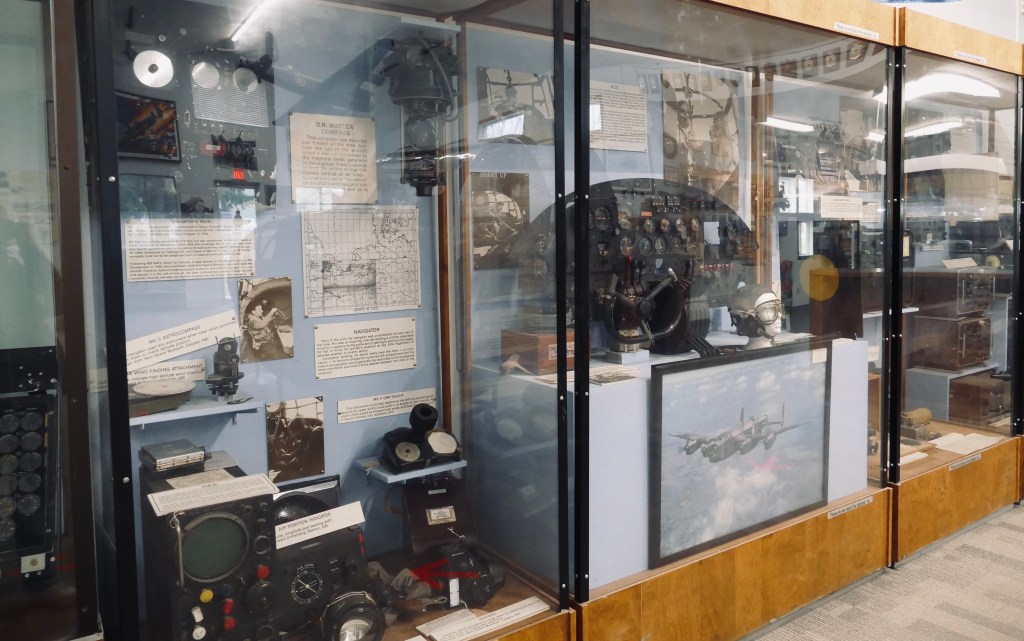
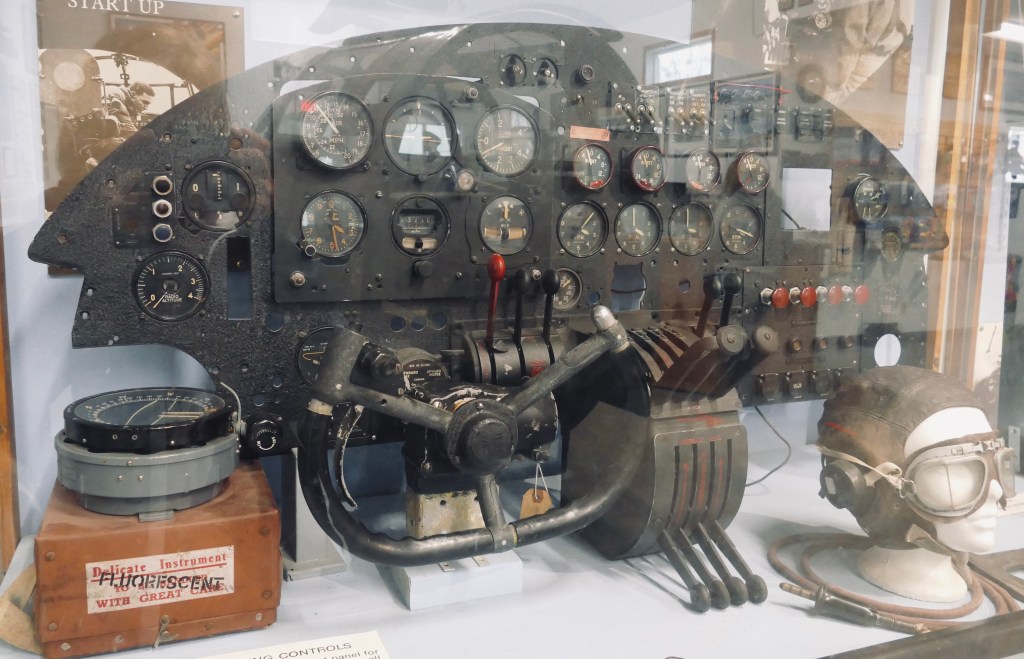
The museum has displays of the instrument panels from the Lancaster bomber airplane.
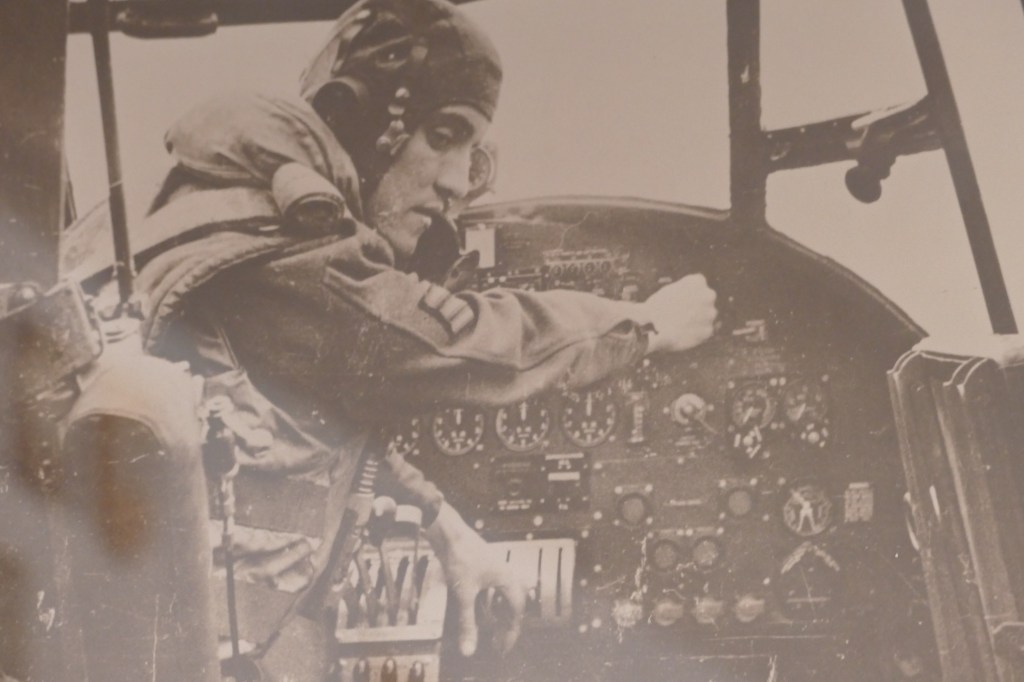
This is the pilot’s instrument panel and flying controls, along with a photograph of a pilot.
The Flight Engineer’s Panel
Dan was checking out the mockup of a Lancaster cockpit that you can sit in. This mockup was used in the 1992 film “Map of the Human Heart.”
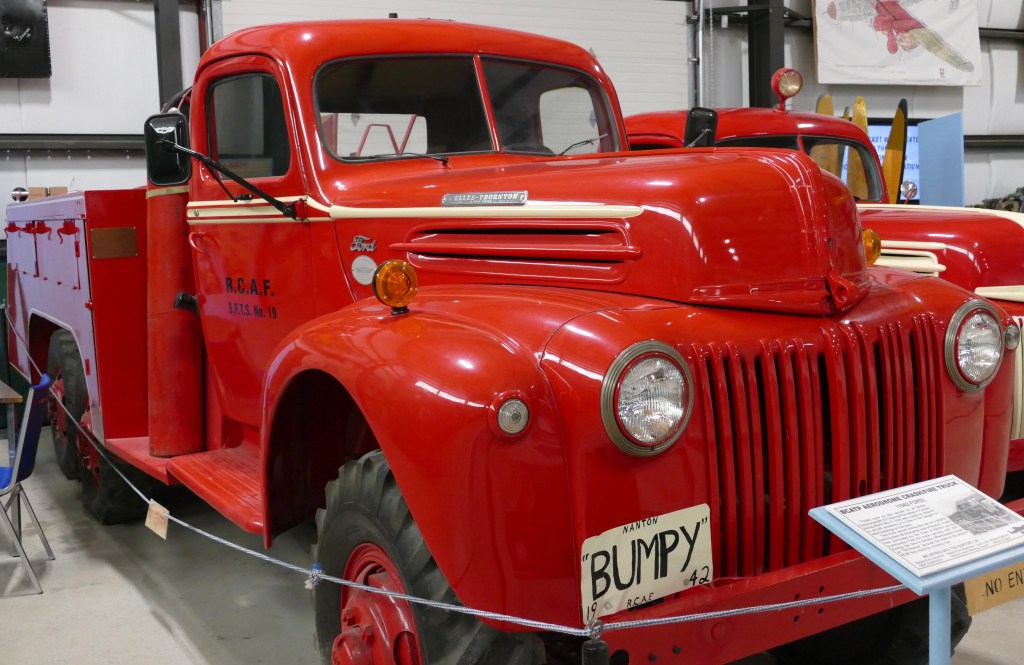
Air training bases in Canada had their own fire department. This is a 1942 Ford Aerodrome/Crash Fire Truck. After the war, the town of Nanton used it as their first fire truck. It remained in service until 1977. It was called “Old Bumpy” due to it’s ride.
This is a 1942 De Havilland Tiger Moth. It was the most widely used basic training airplane under the British Commonwealth Air Training Plan.
In 1939, the Royal Air Force established the Women’s Auxiliary Air Force (WAAF) which grew to 180,000 members during WWII. In 1941, the Royal Canadian Air Force Women’s Division (WD) was formed. Over 17,000 Canadian women joined and served. The museum has a display honoring their service. The women in the Air Force were issued bicycles for transportation.
Canadair CT-114 Tutor. Originally used for training pilots from 1963-2000, the plane is now used by “The Snowbirds,” Canada’s air demonstration team.
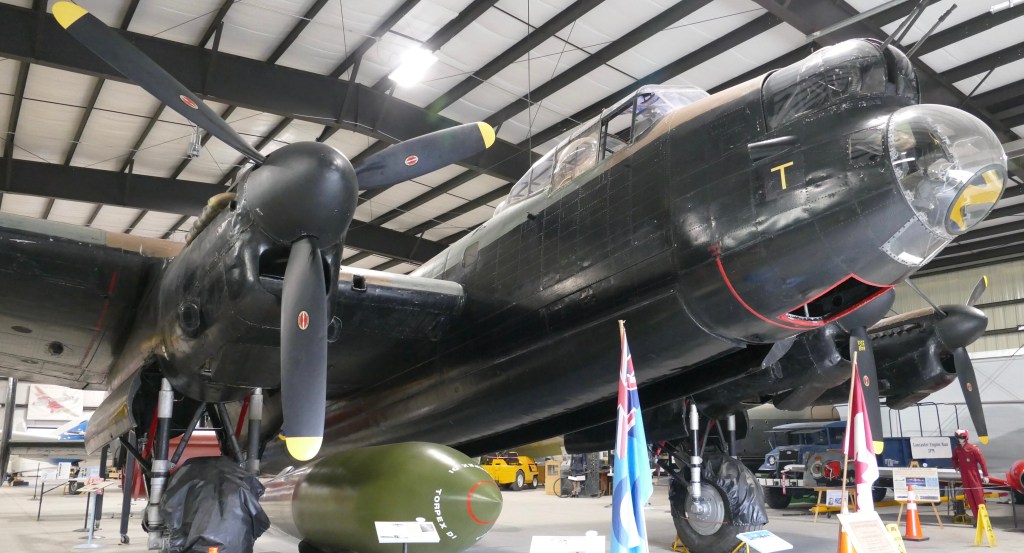
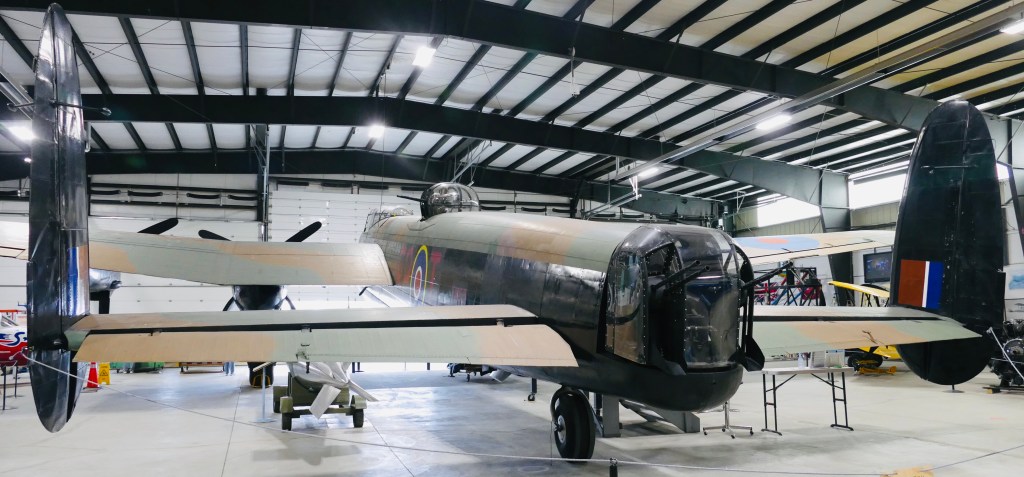
The main feature of the museum is the Lancaster, a heavy bomber plane. It was the most successful bomber used in WWII.
View from the rear
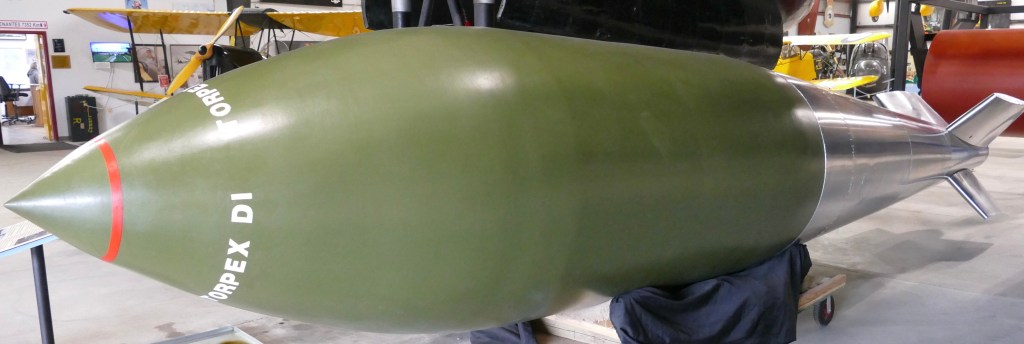
Specially modified Lancaster were used to transport and deploy the Grand Slam Bomb. Forty one of these 22,400 pound bombs were dropped near the end of WWII. The museum houses a full-size mockup of the 25 foot long bomb.
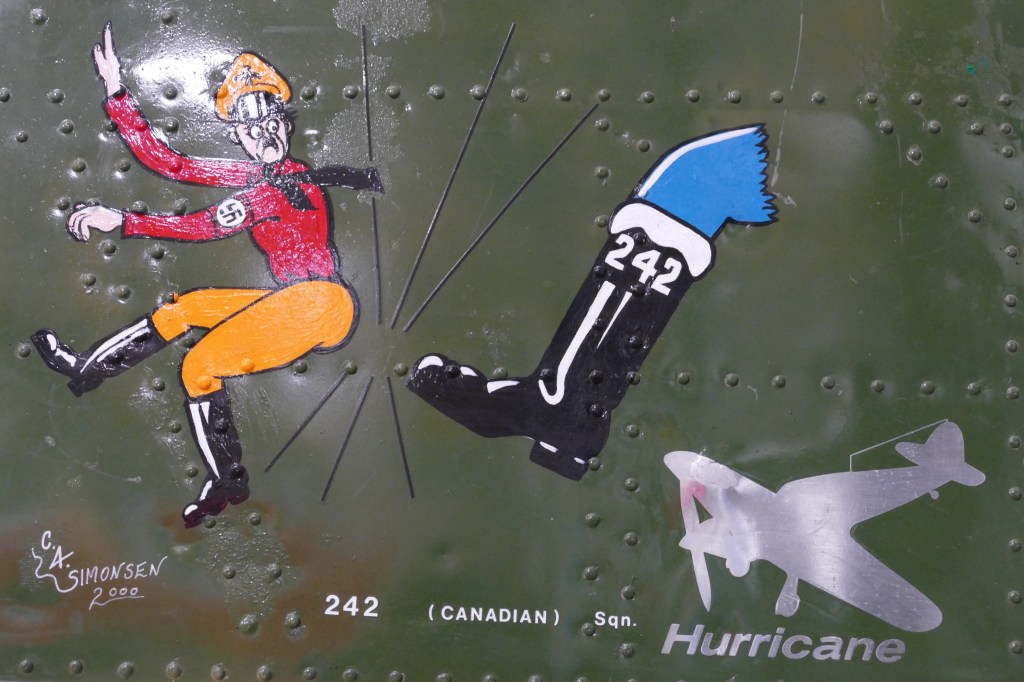
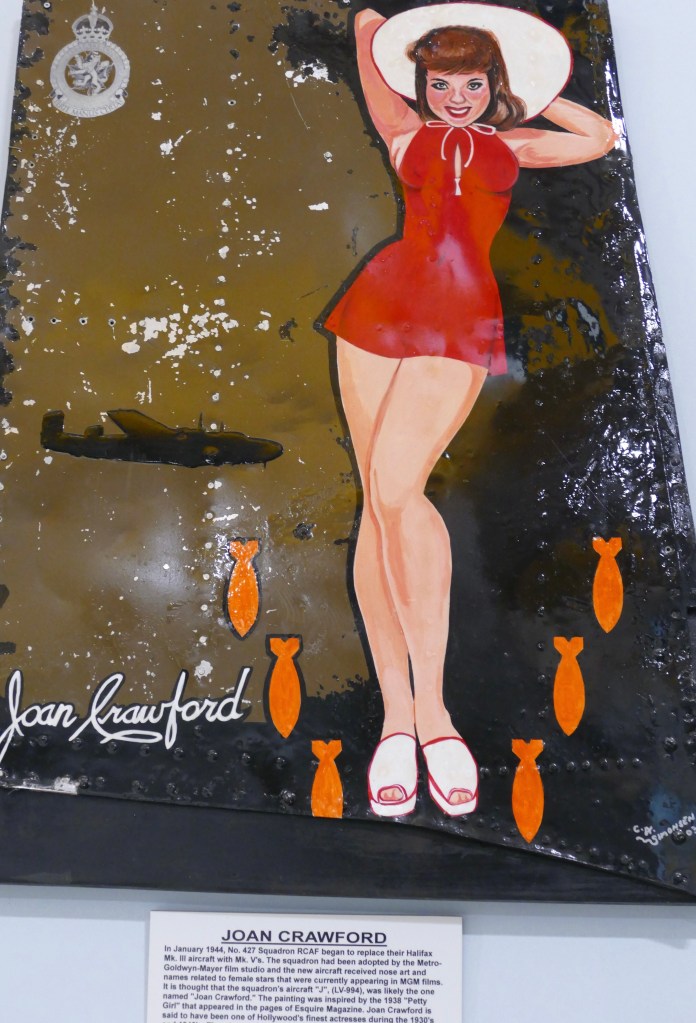
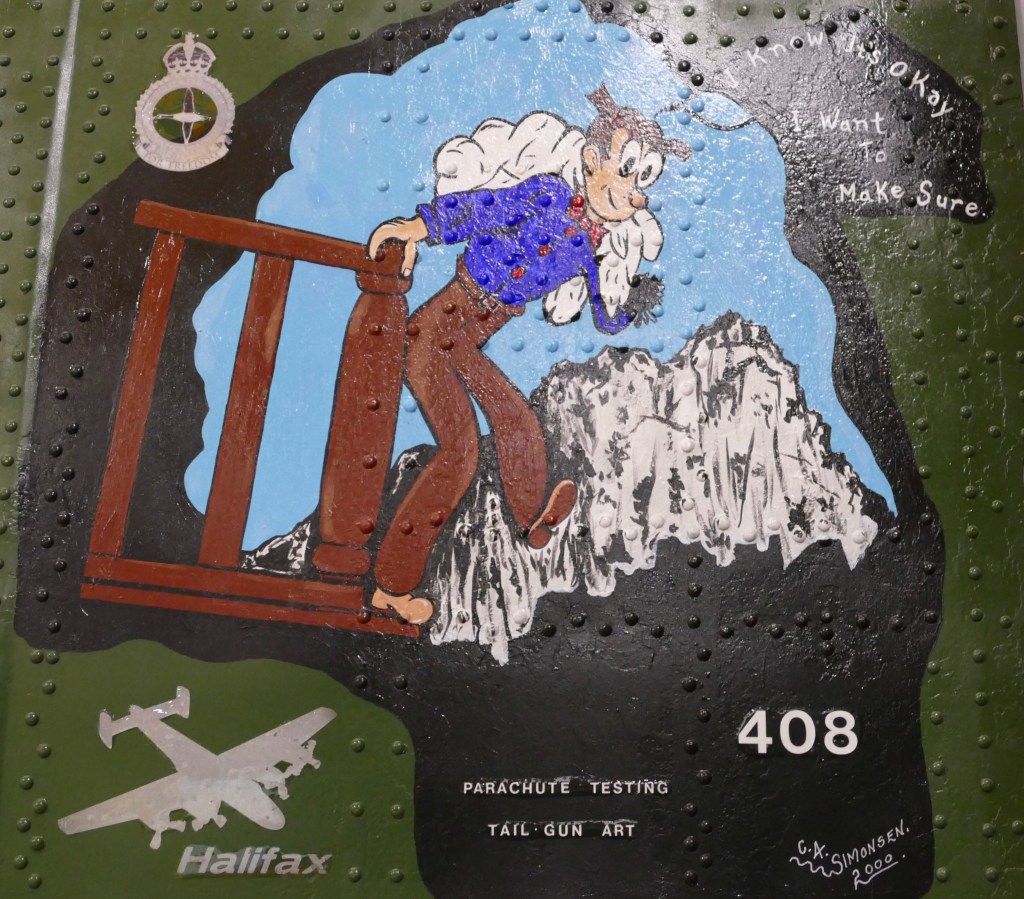
A large number of Nose Art reproductions are contained throughout the museum. We always enjoy looking at the creativity on display.
Quote of the Day: “The Navy can lose us the war, but only the Air Force can win it. The fighters are our salvation, but the bombers alone provide the means of victory.” – Winston Churchill, September 1940 (this quote is on display at the museum)




































































 Liv2RV